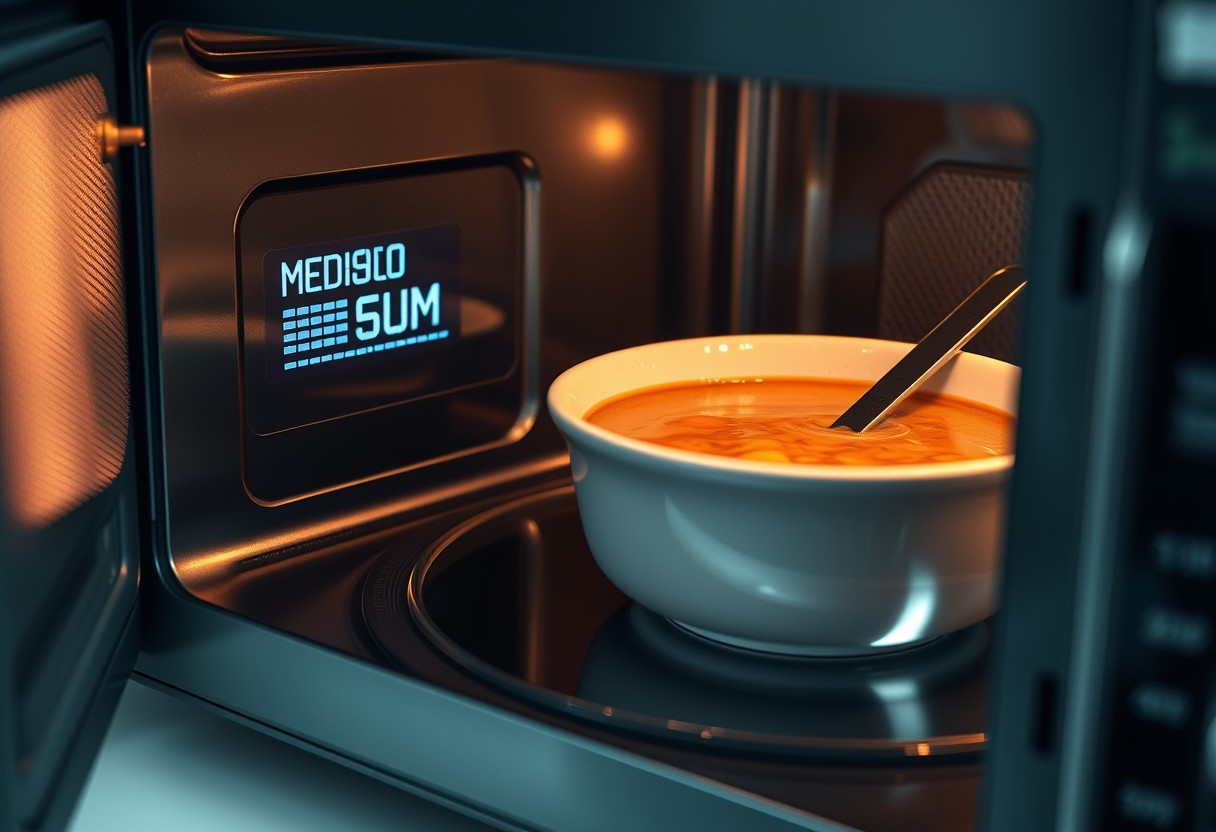
You’ve likely pressed the power button and selected “Medium” without fully understanding what it does. Medium power doesn’t mean less heat-it means cycling the full power on and off. Your microwave runs at 100% for intervals, then shuts down briefly, creating an average output that simulates lower intensity. This method prevents overheating delicate foods while allowing time for heat to distribute evenly. Using medium power incorrectly can lead to uneven cooking or even scalding hotspots, but when applied wisely, it gives you far greater control than full blast ever could.
Key Takeaways:
- Medium power on a microwave does not mean the magnetron produces less energy; instead, it cycles the power on and off, allowing food to heat more evenly without overcooking the edges.
- A setting labeled as 50% power typically runs the microwave at full power for about 10 seconds, then turns off for 10 seconds, repeating this pattern throughout the cooking time.
- Using medium power is especially effective for tasks like softening butter, melting chocolate, or reheating dense foods, where gradual heat absorption prevents hot spots and preserves texture.
The Duty Cycle Dance
Your microwave doesn’t lower heat by reducing the intensity of its magnetron. Instead, it cycles the full-power bursts on and off in timed intervals, creating an average output that mimics lower temperatures. During these off periods, the magnetron shuts down completely, allowing heat to stabilize within the food. This intermittent operation means you’re not getting continuous energy, but rather a series of intense waves separated by stillness. The result is uneven heating unless managed carefully, especially with dense or layered items.
The Pulsing Magnetron
Power levels like 50% don’t mean half-strength radiation-they mean the magnetron runs at full capacity for roughly half the time. At medium power, your microwave might pulse the magnetron on for five seconds, then off for five. During the off phase, no energy is emitted, so cooking relies on residual heat spreading internally. This cycling prevents surface scorching while allowing deeper penetration over time, though gaps in energy delivery can lead to cold spots if stirring or resting isn’t incorporated.
Heat Distribution Realities
You experience temperature fluctuations because the food cools slightly during the magnetron’s off cycles, especially near the surface. While internal moisture retains heat better, exposed areas lose energy rapidly, leading to inconsistent results. Dense portions absorb and hold heat more effectively than thin edges, which may dry out or overcook between pulses. Without manual intervention, such as stirring or rotating, these disparities become more pronounced, undermining the intended gentler cooking effect of medium power.
Calculating the Thermal Load
To effectively manage your cooking outcomes, you need to translate your microwave’s power percentage into actual wattage output. If your microwave operates at 1000 watts on high, setting it to 50% power means it delivers 500 watts during active cycles. This number directly affects how quickly food heats and whether delicate ingredients cook evenly or scorch. Understanding this conversion allows you to replicate recipes accurately and adjust for different appliances, especially when moving between models with varying maximum outputs.
Math for the Hungry
You can calculate usable wattage in seconds by multiplying your microwave’s max output by the decimal form of the power setting. For example, a 700-watt microwave at 30% power uses 210 watts during its on phase. This figure is not theoretical-it reflects real energy entering your food, which determines temperature rise over time. Knowing this helps you estimate heating duration with greater precision, especially when preparing meals that demand consistent thermal input, like custards or melted chocolate.
The Low-Wattage Advantage
Operating at reduced power gives you finer control over heat delivery, preventing sudden overheating in sensitive dishes. When you set your microwave to 40% on a 900-watt unit, you’re working with 360 watts, a level ideal for gently warming sauces or softening butter without melting it entirely. This lower intensity reduces the risk of hotspots and allows heat to distribute more evenly through conduction. The result is more predictable results, especially when handling proteins or dairy-rich mixtures prone to curdling or toughening under full blast.
Defrosting Without Destruction
Using medium power gives dense foods time to thaw evenly without cooking the outer layers. At full power, microwaves concentrate energy rapidly, often leaving edges scorching while the center remains frozen. With medium settings, the lower duty cycle allows heat to migrate inward through conduction, balancing temperature gradients. This is especially important for thick portions of meat or baked goods with fillings, where uneven heating can ruin texture and flavor. You avoid the shock of burnt exteriors and raw interiors by trusting the slower, more controlled agitation that medium power provides.
Softening versus Melting
You achieve precise control over dairy and chocolate when using medium power, turning solid blocks into spreadable textures without crossing into pooling liquid. High heat turns butter or chocolate into separated, greasy messes almost instantly, but at 50% power, the gradual energy transfer gently loosens molecular bonds just enough to soften. This prevents overheating sensitive ingredients that respond poorly to sudden temperature spikes. You maintain consistency and usability, ensuring your brie stays creamy and your cocoa butter doesn’t split.
The Molecular Agitation Factor
Microwaves excite water molecules, and at full power, this agitation happens so intensely that it generates steam before heat can distribute. Medium power reduces the intensity of each burst, giving time for thermal equilibrium to occur across the food. This means you prevent localized boiling pockets that rupture cell walls or create rubbery textures. The slower excitation process preserves structure and moisture, especially in protein-rich or dense carbohydrate dishes, resulting in a final product that’s uniformly warmed-not fractured by explosive heat.
The Geometry of the Vessel
How your container interacts with medium-power microwaves directly influences heating efficiency and safety. Materials like glass and ceramic respond differently to sustained energy pulses than metals or plastics, affecting both temperature distribution and cooking time. The shape and depth of the vessel further modulate how waves penetrate and reflect within the chamber. Choosing the right combination ensures even warmth without hotspots or unexpected boiling events. Your selection isn’t just about convenience-it’s a critical factor in controlling thermal outcomes during lower-intensity cycles.
Glass and Ceramic Dynamics
You rely on glass and ceramic dishes because they typically allow microwaves to pass through with minimal absorption at medium power. These materials don’t reflect energy like metal, nor do they melt under moderate heat like some plastics. Instead, they remain relatively cool while letting the food absorb the waves, though prolonged exposure can still cause surface temperatures to rise. A thick ceramic bowl may retain heat longer, creating residual cooking after the cycle ends-a hidden source of overcooking if not accounted for when removing items.
Shape and Depth Impacts
Your container’s form dictates how evenly energy reaches all parts of the meal. Wide, shallow dishes expose more surface area to microwaves, promoting uniform warming at medium intensity. In contrast, deep or narrow vessels create pockets where waves struggle to penetrate, leading to cold centers despite extended run times. Corners and edges in square containers can concentrate energy, risking premature steaming or drying. A rounded, low-profile shape gives you the best chance for consistent results, reducing the risk of unexpected scalding from trapped steam bursts.
The Rotation Factor
Your microwave’s turntable isn’t just spinning for show-it’s actively disrupting electromagnetic hot spots that form inside the cavity. Without rotation, standing waves create zones of intense energy and cold pockets, leading to uneven cooking. The continuous movement ensures that food passes through these varying zones, promoting uniform exposure. This dynamic helps prevent localized overheating, especially in dense or moisture-rich areas, reducing the risk of scalding or undercooked sections. For complete technical details on how your model manages energy distribution, consult the MICROWAVE OVEN USER MANUAL – Cloudfront.net.
Eliminating Standing Waves
Standing waves occur when microwaves reflect off the metal walls and interfere with incoming waves, creating fixed patterns of high and low energy. These patterns result in predictable hot and cold spots, often forming a grid-like distribution across the cavity floor. Your turntable disrupts this stability by constantly repositioning the food, preventing any one area from absorbing excessive energy. This motion breaks the resonance conditions needed for standing waves to persist, significantly improving heating consistency and reducing the chance of unexpected steam bursts or cold centers in your meal.
Off-Center Placement Benefits
Placing food off-center on the turntable enhances exposure to varying field intensities as it rotates. Since microwave energy is typically concentrated toward the outer edges of the cavity, centering a dish limits its interaction with stronger zones. By shifting the container slightly away from the middle, you allow it to sweep through a broader range of energy levels during each rotation. This improves thermal averaging and helps achieve more balanced cooking, especially for items prone to uneven heating like casseroles or thick sauces.
Temporal Adjustments for Success
The Time-Power Tradeoff
Lowering your microwave’s power setting reduces the intensity of energy delivered to the food, which means you must increase the cooking time to achieve the same thermal result. At medium power (typically 50%), the magnetron cycles on and off, delivering energy in bursts rather than continuously. This intermittent output slows the overall heating process, so relying on default cook times from high-power settings leads to undercooked or unevenly heated meals. Adjusting duration compensates for reduced intensity, ensuring food reaches a safe internal temperature throughout.
Achieving Even Results
Extended cooking at medium power gives heat more time to spread through the food, reducing hot spots and improving consistency. Because lower power allows thermal energy to conduct inward before the outer layers overcook, delicate dishes like custards or sauces respond better when given this gradual approach. You’ll find that simmering foods without scorching edges becomes far more achievable, especially when you pair increased time with periodic stirring. Patience here isn’t optional-it’s part of the method that delivers balanced, reliable outcomes across varied ingredients.
Conclusion
You now understand that “medium power” on a microwave refers to cycling the magnetron on and off during heating, not reducing its intensity. By operating at around 50% duty cycle, your food receives bursts of full power followed by rest periods, allowing heat to distribute more evenly. This method prevents overheating edges while enabling thicker portions to warm through gradually. Whether you’re defrosting meat or reheating leftovers, selecting medium power gives you control over thermal distribution. You use it to balance speed with precision, ensuring better results than full power alone.
FAQ
Q: What power level is considered “medium” on most microwaves?
A: Medium power on a microwave typically refers to 50% of the appliance’s maximum wattage, often labeled as “Power Level 5” on models with a scale from 1 to 10. For example, if your microwave operates at 1000 watts, medium power would deliver 500 watts of cooking energy. This setting allows food to heat more evenly than full power by cycling the magnetron on and off during operation, reducing the risk of overheating edges while leaving centers cold.
Q: How does medium power affect cooking time compared to high power?
A: Cooking on medium power generally requires longer times than high power because the microwave emits less energy over the same period. A dish that takes 4 minutes on high might need 6 to 8 minutes on medium to reach the same internal temperature. The extended duration helps heat penetrate dense foods like casseroles or thick cuts of meat without causing surface scorching or rubbery textures in proteins such as fish or chicken.
Q: Why do some recipes specifically call for medium power instead of high?
A: Recipes use medium power when precise thermal control is needed to prevent overheating delicate ingredients. Melting chocolate, softening butter, or reheating dairy-based sauces are common examples where high power can cause separation or burning. Medium power provides gentler heating, allowing better control over temperature-sensitive processes and minimizing hot spots that lead to inconsistent results.
Q: Can you simulate medium power on a microwave without power level settings?
A: Microwaves lacking adjustable power levels operate only at full output, but you can approximate medium power by using timed intervals. For instance, instead of running the microwave continuously for 5 minutes, pulse it-30 seconds on, 30 seconds off-to average out the energy delivery. While not as consistent as true medium power, this method reduces overcooking risks and works reasonably well for reheating meals or defrosting items slowly.
Q: Does using medium power save energy compared to high power?
A: Running a microwave on medium power does not reduce total energy consumption; in fact, it may use slightly more due to longer cycle times. A 1000-watt microwave drawing 500 watts on medium for 6 minutes consumes about the same electricity as running at full power for 3 minutes. The benefit lies in improved food quality, not efficiency. Energy use depends on both wattage and duration, so extended cooking offsets any per-minute savings from lower output.