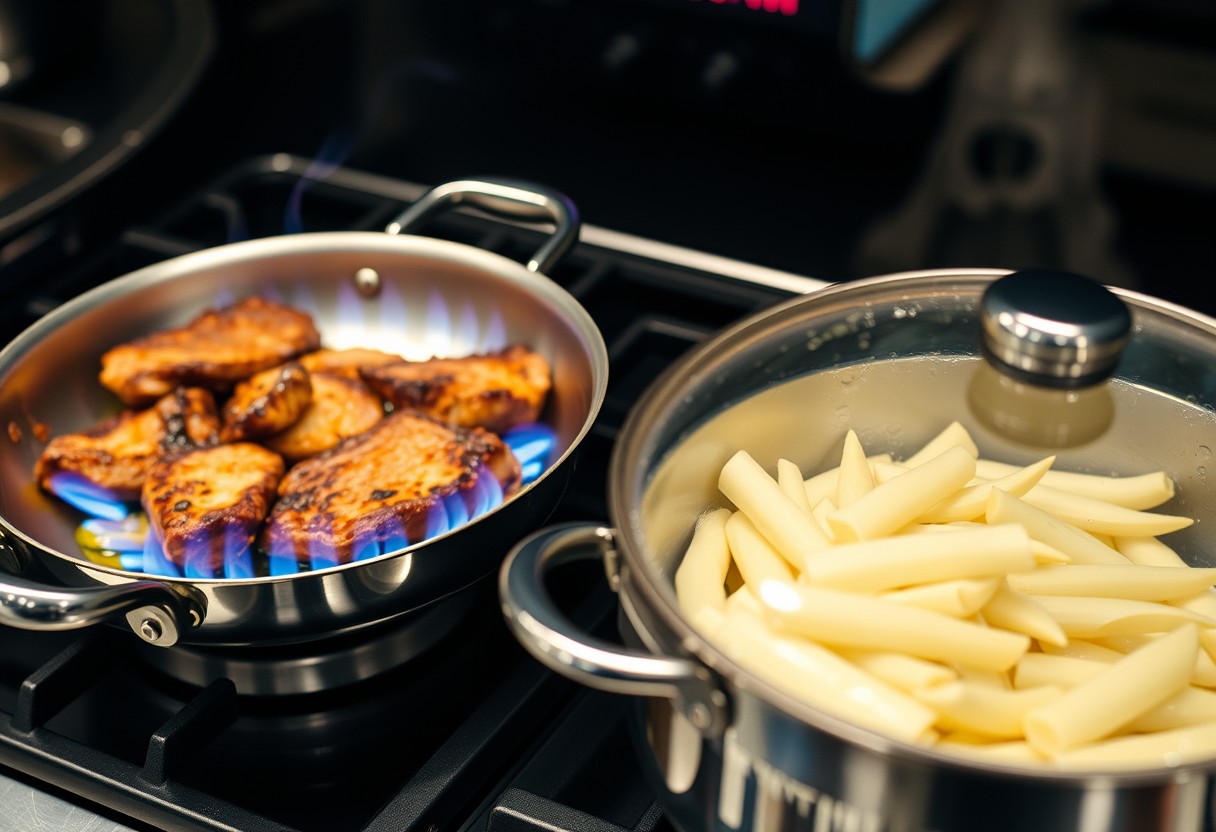
You’ve likely seared a steak or sautéed vegetables only to find them steaming instead of browning, even on high heat. The difference lies in your pan’s material and how it transfers energy. Proper browning requires rapid, even heat delivery-something not all cookware provides. When moisture lingers instead of evaporating quickly, the food steams, robbing it of rich, complex flavor. Understanding this balance gives you control over one of cooking’s most transformative reactions.
Key Takeaways:
- Different pan materials conduct heat at varying rates, affecting whether food browns or steams; for example, stainless steel promotes browning while nonstick surfaces often lead to steaming due to lower thermal conductivity.
- A crowded pan traps moisture released from food, creating a steam environment that inhibits browning-keeping space between ingredients helps achieve a crisp, caramelized exterior.
- The presence and type of fat in the pan influences heat transfer and the Maillard reaction, with oils that withstand high heat enabling faster, more even browning compared to dry or waterlogged cooking surfaces.
The Maillard Reaction
When proteins and sugars in your food meet high heat, a complex chemical transformation begins on the surface of what you’re cooking. This is the Maillard reaction-a cascade of molecular changes that generates hundreds of flavor compounds responsible for rich, savory depth. You’re not just browning food; you’re creating entirely new aromas and tastes through reactions between amino acids and reducing sugars. Temperatures must exceed 285°F (140°C) for this to occur, which is why low-heat cooking rarely achieves the same complexity.
Amino Acid Reconfiguration
Amino acids in proteins shift their structure when exposed to intense heat, opening pathways for reactive bonding with sugars. This reconfiguration initiates the first stage of the Maillard reaction, forming unstable intermediates that quickly break down into flavorful molecules. The specific combination of amino acids present determines the final taste profile, whether nutty, meaty, or roasted. Your choice of ingredient-beef, mushrooms, or onions-shapes this outcome at a molecular level, making each sear uniquely flavorful.
Carbonization vs. Caramelization
Caramelization involves only sugars breaking down under heat, producing sweet, buttery notes as they transform into new compounds. Carbonization, however, occurs when organic matter burns, leading to bitter, acrid flavors and blackened residues. You cross into carbonization when heat exceeds what the food can handle, destroying desirable flavors instead of building them. While both processes darken food, only controlled Maillard browning delivers the complexity you want without tipping into ruin.
Thermal Conductivity
Your pan’s metal dictates how quickly and evenly energy reaches the food’s surface. Materials like aluminum and copper transfer heat rapidly due to high thermal conductivity, creating immediate contact searing. In contrast, cast iron conducts more slowly but holds energy longer, promoting steady browning once equilibrium is reached. The difference lies not just in speed but in how each metal stores and releases thermal energy under load. This behavior determines whether proteins seize up instantly or gradually develop a rich crust.
Cast Iron Heat Retention
Cast iron excels at storing large amounts of thermal energy, meaning it maintains high surface temperatures even when cold food is added. You benefit from consistent browning because the pan doesn’t experience sharp drops in heat during cooking. This stability prevents premature steaming and supports sustained Maillard development. While slower to warm up, its dense structure ensures that once hot, it delivers reliable, even searing ideal for steaks and seared vegetables.
Stainless Steel Response Time
Stainless steel responds more quickly to adjustments in burner output than cast iron, giving you tighter control over cooking temperature. Though it doesn’t retain heat as densely, its layered construction-often with an aluminum or copper core-balances responsiveness with distribution. You can correct overheating or boost heat mid-sear with noticeable immediacy, making it a preferred choice for delicate reductions and pan sauces where precision matters alongside browning capability.
The Steam Barrier
Water trapped beneath your food acts as an insulating layer that keeps the pan surface from reaching temperatures needed for browning. As long as excess moisture remains, the pan cannot exceed the boiling point of water-212°F (100°C)-because energy from the heat source goes into evaporating the liquid rather than raising the temperature. This creates a persistent cooling effect that prevents direct contact between food and sufficiently hot metal, resulting in steaming instead of searing.
Evaporative Cooling Mechanics
Each gram of water that turns into vapor absorbs a significant amount of heat from the pan’s surface, a process known as evaporative cooling. This energy draw keeps the immediate cooking zone at or near boiling temperature, even if the burner is delivering high heat. Until all surface moisture evaporates, your food remains in a steam-dominated environment, making it impossible to achieve a proper sear. Patience and dry ingredients are your best tools here.
Surface Crowding Pitfalls
Overloading the pan forces moisture to pool between pieces of food instead of escaping into the air. With no space for steam to dissipate, the trapped vapor condenses back onto the surface, creating a continuous wet layer. This environment actively suppresses browning and promotes uneven, soggy results. For optimal contact and drying, give each piece room to breathe-cooking in batches may be necessary for consistent searing.
Heat Source Dynamics
High heat output isn’t just helpful for browning-it’s non-negotiable when you need consistent searing. When food hits the pan, it pulls energy from the surface, and if your heat source can’t replenish that loss quickly, temperatures drop below the threshold for Maillard. You end up with gray, steamed results instead of rich, complex crusts. Maintaining browning means your stove must deliver intense, immediate energy to offset the thermal load of the food.
BTU Output and Recovery
Home gas burners often max out around 9,000 to 12,000 BTUs, but high-heat cooking demands more. A burner with strong BTU output can recover lost heat the moment a steak hits the pan, keeping surface temperatures above 300°F-the minimum for effective browning. If recovery is slow, moisture lingers, steam builds, and color stalls. For reliable searing, especially with thick or cold ingredients, a burner’s ability to rebound matters as much as its peak output.
Induction vs. Gas Performance
Induction cooktops respond faster than gas because they heat the pan directly through magnetic fields, not open flames. When you adjust the power, the change is instantaneous, allowing tighter control during high-heat searing. Gas provides visual feedback and flexibility, but induction maintains more consistent energy delivery, especially when pans shift or boil over. For precision and speed in heat recovery, induction holds a clear edge in environments where timing defines success.
Lipid Heat Transfer
You rely on oil to create direct contact between the pan’s surface and your food, eliminating air pockets that inhibit browning. When heated, the oil acts as a thermal bridge, transferring energy evenly across the food’s exterior. This continuous flow of heat enables the surface temperature to rise quickly, reaching the threshold needed for Maillard reactions without scorching. Without this layer, moisture would dominate, leading to steaming rather than searing, so the choice and amount of oil directly influence whether you achieve rich color or pale texture.
Smoke Point Thresholds
Every oil has a limit where it begins to break down and release visible smoke, signaling the start of degradation. Staying below this point ensures flavor integrity and prevents harmful compounds from forming. If you exceed the smoke point, not only does the oil impart a bitter taste, but its ability to transfer heat efficiently drops sharply. Choosing an oil with a high enough smoke point-like avocado or refined safflower-keeps the cooking environment stable and protects both the quality of the sear and your health.
Surface Area Contact
Maximizing how much of your food touches the oiled pan surface directly increases browning potential. A thin film of oil fills microscopic gaps between skillet and ingredient, replacing trapped air and enabling consistent conduction. When too little oil is used, uneven patches result in spotty coloration and mixed textures. Conversely, pooling too much can cause shallow frying instead of searing. For best results, apply just enough oil to coat the base without leaving excess fluid around the edges.
To wrap up
You now understand that browning depends on more than just heat-it hinges on how your pan manages moisture, conductivity, and fat distribution. A hot, dry surface promotes the Maillard reaction by rapidly evaporating surface water, while overcrowding or a cool pan traps steam, leading to soggy results. Materials like cast iron retain heat well and support consistent browning, whereas thinner pans may create uneven zones. You control the outcome through preheating, spacing, and choosing the right fat. Mastery comes not from guesswork but from recognizing these physical principles at work in every sear.
FAQ
Q: Why does food brown in a stainless steel pan but steam in a nonstick one?
A: Stainless steel pans conduct heat evenly and reach higher surface temperatures, creating ideal conditions for the Maillard reaction. Nonstick coatings reduce direct metal-to-food contact and often prevent the pan from safely handling the high heat needed for browning. When food hits a cooler or less conductive surface, moisture escapes slowly, forming a steam barrier that inhibits browning and promotes steaming instead.
Q: Can I achieve browning in a nonstick pan if I preheat it longer?
A: Most nonstick pans have temperature limits around 500°F (260°C), beyond which the coating can degrade. Even with extended preheating, they rarely maintain the consistent high heat required for effective browning. A heavy stainless steel or cast iron skillet retains and delivers heat more efficiently, allowing proteins and sugars in food to react and form a browned crust quickly before moisture accumulates.
Q: Does oil type affect whether food browns or steams?
A: Yes, oils with high smoke points-like avocado, grapeseed, or refined peanut oil-can heat to higher temperatures without breaking down, supporting rapid searing. Using butter or olive oil at very high heat may lead to burning or smoking too soon, limiting your ability to sustain the heat needed for browning. The right oil helps maintain a hot, dry interface between pan and food, reducing steam buildup.
Q: Why does crowding the pan cause food to steam instead of brown?
A: Adding too much food at once lowers the pan’s surface temperature rapidly. Excess moisture released from the food cannot evaporate quickly when space is limited, creating a humid microenvironment. Each piece essentially sits in its own vapor, triggering steaming. Cooking in batches with adequate spacing lets moisture escape and allows the pan to recover heat between additions.
Q: Is there a way to make vegetables brown instead of steam in a pan?
A: Start with dry vegetables and a well-heated pan. Water on the surface immediately turns to steam upon contact, blocking browning. Slicing vegetables uniformly and placing them in a single layer without overlap maximizes contact with the hot surface. Let them sit undisturbed for several minutes to develop color before stirring. A carbon steel or cast iron pan works better than thin aluminum or coated pans for this task.