You’ve carefully crafted your sauce, only to find it split or greasy just before serving. This separation isn’t just unappetizing-it can signal broken emulsions or overheated ingredients. The good news? You can often fix it quickly with simple, science-backed techniques. Understanding why sauces fail gives you the power to correct them-and prevent future breakdowns.

Key Takeaways:
- Homemade sauces separate when the emulsion breaks, often due to temperature shock or adding fat too quickly-maintaining a steady pace and temperature during mixing keeps ingredients bonded.
- Recovering a separated sauce is usually possible: slowly whisk in a spoonful of water or a fresh emulsifier like egg yolk to help reattach the loose fat molecules.
- Starch-based thickeners like flour or cornstarch can stabilize sauces prone to splitting, especially in dishes that require reheating or prolonged simmering.
The Molecular Civil War
Even when heated, oil and water refuse to form a lasting alliance. You’re not just battling poor technique-you’re fighting molecular incompatibility. Oil molecules are nonpolar, repelled by the polar structure of water, creating an unstable mixture that collapses the moment agitation stops. This natural resistance isn’t a flaw in your cooking; it’s physics asserting itself in real time. The longer the sauce sits off constant motion, the faster the separation becomes visually obvious and irreversible without intervention.
Fat Versus Water
Oil floats because it’s less dense than water, but that’s not the real issue. Once combined, these liquids exist in temporary truce, held together only by mechanical force. Heat doesn’t merge them-it only thins the oil, giving a false impression of integration. When energy drops, the fundamental polarity gap reasserts control. Your sauce splits not due to bad ingredients, but because nature favors division over unity between these two substances.
The Breaking Point
Temperature swings accelerate the divorce between fat and liquid. A slight cool-down in the pan crosses a threshold where emulsion stability vanishes. At this stage, even gentle movement won’t bring the sauce back-the structural collapse is already complete. What you see as oily pools or watery streaks is evidence of that precise moment when cohesion failed. Recognizing this shift early gives you a narrow window to act before presentation is compromised.
Battlefield Repairs
When your sauce splits, immediate physical intervention can still save the dish. The core goal is to force the dispersed fat and liquid back into unity through mechanical energy. Your best tool in this moment is consistent, vigorous agitation, which helps rebuild the broken emulsion by shrinking droplet size and encouraging even distribution. Success depends on both speed and duration-brief or timid stirring rarely suffices. Apply steady effort and monitor texture closely, as visual cues signal whether reintegration is taking hold or further measures are needed.
The Violent Whisk
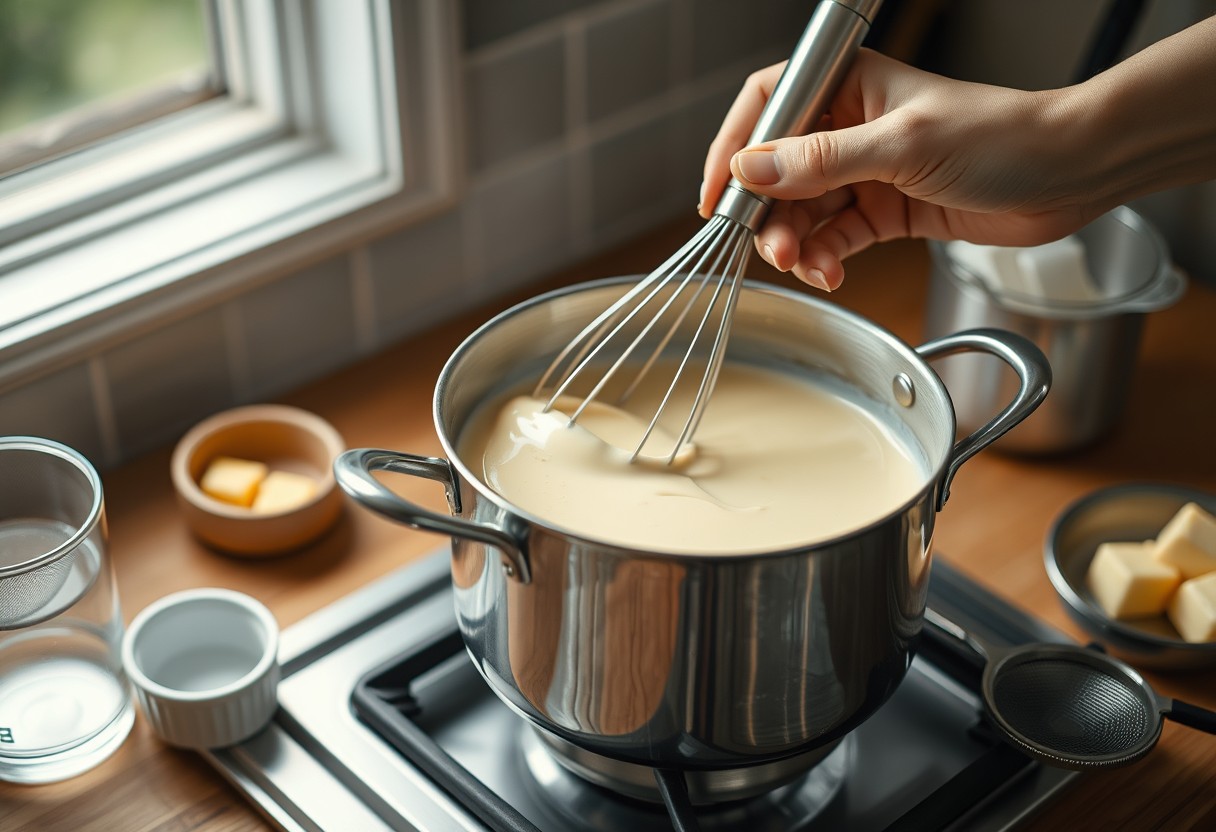
You can often rescue a separating sauce with nothing more than a whisk and determination. Place the pan over low heat and begin whisking in rapid, tight circles, ensuring the motion reaches all corners of the bottom and sides. This intense agitation reintroduces shear force, helping trapped oil droplets re-embed into the aqueous phase. If the sauce begins to thicken slightly and regain a glossy sheen, you’re on the right track. Stop heating at the first sign of cohesion-overheating now will undo your progress and push it past recovery.
The Blender Rescue
A blender offers a powerful alternative when hand-whisking fails or you’re dealing with larger volumes. Pour the broken sauce into the pitcher and secure the lid tightly-steam pressure can cause dangerous spills if ignored. Start blending at low speed, then gradually increase to high for 20-30 seconds. The high-speed blades generate intense turbulence, effectively re-emulsifying the mixture far more efficiently than manual methods. Once smooth and uniform, transfer immediately to a warm serving vessel to maintain stability.
Chemical Reinforcements
When your sauce threatens to split, structural support from common pantry ingredients can rescue the texture. Flour and eggs act as powerful stabilizers by reinforcing the mixture’s ability to hold fat and liquid together. These agents introduce proteins and starches that form a network capable of trapping moisture and preventing separation. You’re not just thickening-you’re rebuilding the sauce’s internal architecture. Applied correctly, they transform a fragile emulsion into something far more resilient.
Starch Sabotage
If you dump flour directly into a hot sauce, you’ll likely end up with lumps and uneven texture instead of smooth stability. The problem lies in how raw starch granules clump when exposed to moisture without proper dispersion. To avoid this, always mix flour with a small amount of cold liquid or fat before incorporating it into the main mixture. Skipping this step risks grainy patches and weak bonding, undermining the entire emulsion. When used wisely, starch becomes a silent ally-but only if treated with care.
The Egg Yolk Miracle
Egg yolks contain lecithin, a natural emulsifier that excels at binding oil and water-based components in sauces like hollandaise or béarnaise. When you whisk yolk into a warm (not hot) base, its proteins gently unfold and lock fats into place, creating a rich, cohesive texture. Adding it too quickly or over high heat will cause scrambling instead of smoothing. Temper the yolk gradually, letting it stabilize the mixture without breaking down-this is where true control reveals itself in silky results.
Fire Control Failures
Exposing your sauce to extreme temperatures destabilizes its structure, causing components to split apart with surprising speed. High heat forces fats to weep out and proteins to seize up, especially in dairy-based or emulsified sauces where balance is delicate. Even a few seconds too long over intense flame can ruin hours of careful preparation. Keep your burner set low and pay close attention-the difference between silky smooth and irreparably broken often comes down to a single degree. For inspiration on mastering temperature-sensitive sauces, try this Caramel Sauce | Recipe By My Name Is Snickerdoodle, which demands precise heat management.
Scorching the Bottom
Letting your sauce sit too long on a hot surface without stirring risks burning the layer in direct contact with the pan. This scorched foundation introduces bitterness and can spoil the entire batch, even if the top appears fine. Once you smell that sharp, acrid note, the damage is likely irreversible. You must stir constantly over medium to low heat, using a flat-edged spatula to reach into corners where residue collects. Never assume the surface movement means the bottom is safe-temperature gradients within the pot are deceptive and unforgiving.
The Simmer Trap
Simmering seems gentle, but an unregulated simmer can push your sauce past its stability threshold. Bubbles breaking too vigorously agitate delicate emulsions, forcing oils and liquids to separate. A true simmer barely breaks the surface-any more than that and you’re risking structural collapse. Use a heavy-bottomed pot to distribute heat evenly and keep the lid slightly ajar to monitor activity. Your sauce should whisper, not bubble aggressively, ensuring cohesion stays intact until serving time.
Specialized Operations
When standard fixes fail, your sauce demands targeted strategies that address its unique chemistry. Hollandaise and pan gravies present distinct challenges due to their opposing foundations-emulsified fats versus meat-based reductions-requiring precise interventions. You must treat each according to its structure, temperature sensitivity, and ingredient balance. Applying the wrong method can irreversibly break an already fragile sauce, turning richness into regret. Success lies in recognizing which technique belongs to which sauce before making a move.
The Hollandaise Crisis
Hollandaise collapses when heat overwhelms the delicate egg yolk and butter emulsion. If your sauce splits, stop heating immediately-continued exposure is the fastest route to ruin. Rescue it by whisking a teaspoon of cold water into a fresh yolk over low heat, then slowly drizzling in the broken sauce drop by drop. The new base reintegrates the fat, restoring silkiness. Never pour the broken mixture all at once; doing so will overwhelm the emulsion and waste your effort.
Pan Sauce Redemption
Pan sauces often separate when deglazing liquids aren’t reduced enough or cold butter is added too quickly. To prevent this, reduce your wine or stock by half before introducing butter off the heat. Swirl in chilled butter one tablespoon at a time, letting each melt fully before adding more. This gradual incorporation creates a glossy, cohesive finish that clings to proteins. If separation occurs, a small spoonful of cold, heavy cream can re-bond the elements without dulling flavor.
To wrap up
You now know that sauce separation stems from unstable emulsions, temperature missteps, or ingredient imbalances. You’ve seen how fats and liquids naturally resist unity without proper technique. You can prevent this by controlling heat, choosing the right thickeners, and emulsifying gradually. If separation occurs, simple fixes like a quick whisk, ice bath, or splash of cream often restore harmony. You’ve built the skills to assess, correct, and serve a smooth, cohesive sauce every time. Confidence in the kitchen grows with each corrected dish, and you’re ready for the next one.
FAQ
Q: Why does my homemade sauce separate when I make it?
A: Homemade sauces separate because the fat and water-based components don’t stay bonded. Emulsions rely on molecules with one end attracted to water and the other to oil. When these bonds break-due to too much heat, insufficient emulsifiers, or adding fat too quickly-the sauce collapses. A classic example is hollandaise splitting after being pulled from the heat too late.
Q: Can I fix a separated sauce after it’s already happened?
A: Yes, most broken sauces can be repaired. For an oily-looking mixture like a split vinaigrette or mayonnaise, whisk in a small amount of liquid-water, vinegar, or even lemon juice-to help re-form the emulsion. With egg-based sauces such as hollandaise, start a new base with a teaspoon of warm water or reduction and slowly whisk in the broken sauce, drop by drop at first, until it regains texture.
Q: Does temperature affect whether a sauce stays together?
A: Temperature plays a direct role in emulsion stability. High heat can denature proteins that act as binders, while sudden cooling might solidify fats before they disperse evenly. A béarnaise left over a burner for too long will curdle, just as a cooled aioli may weep liquid if refrigerated too soon after blending.
Q: What ingredients help prevent separation in homemade sauces?
A: Egg yolks, mustard, garlic paste, and cooked starches act as natural emulsifiers. Mustard contains compounds that stabilize oil-in-vinegar mixtures, which is why it’s often added to vinaigrettes. In cheese sauces, a roux made from butter and flour helps suspend dairy without clumping, especially when warm milk is incorporated gradually.
Q: Should I reheat a sauce that has separated?
A: Reheating a broken sauce without repair usually makes it worse. Instead, address the separation first using one of the restoration methods, then gently warm it. A remade sauce reheated over low heat with constant stirring-like a rescued cheese sauce brought back with a splash of warm milk-will perform far better than simply microwaving the original split batch.