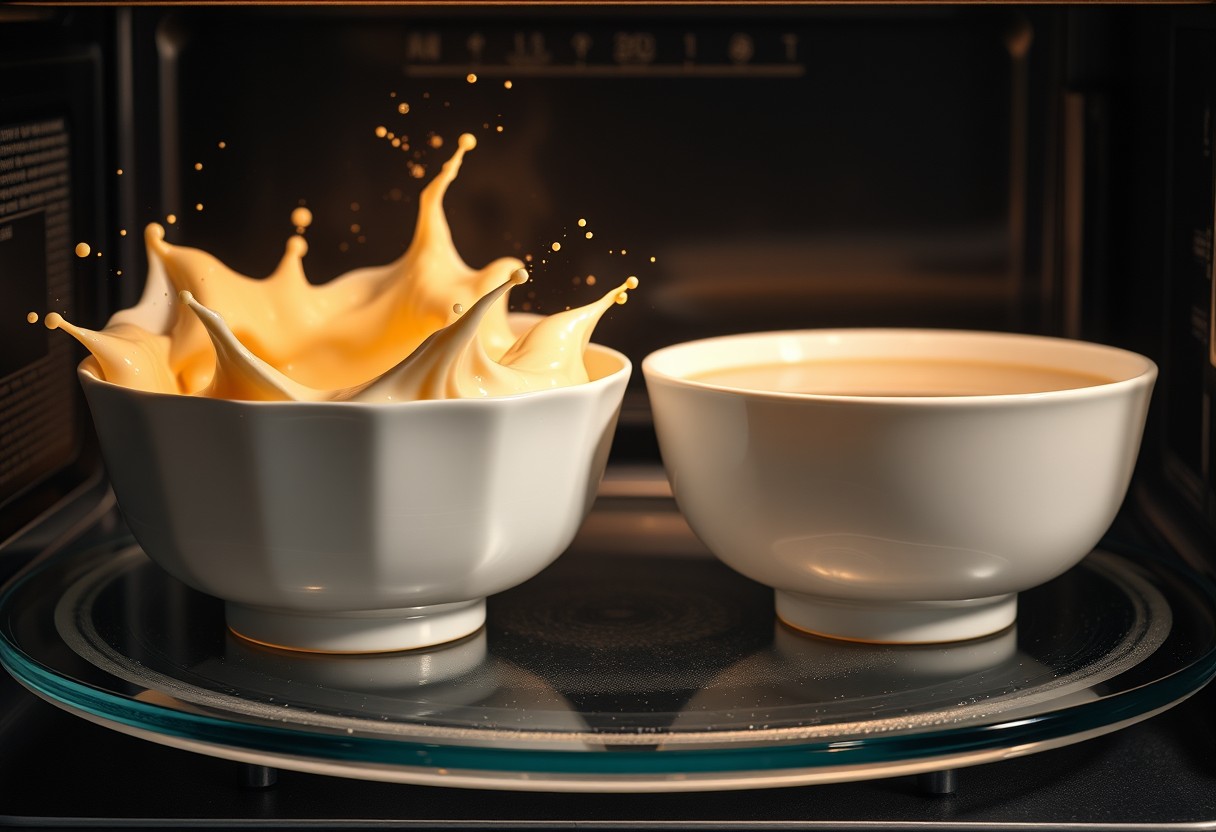
You’ve likely watched your soup rise violently in the microwave, spilling over without warning. This sudden eruption isn’t random-it’s physics. Denser, starch-rich soups trap steam beneath a thick surface layer, building pressure until they explode. In contrast, thinner broths release vapor steadily. Understanding this can prevent burns and messes, while revealing how ingredients and container shape quietly control the outcome.

Key Takeaways:
- Soups with high starch content, like cream-based or pureed varieties, thicken when heated and trap steam, increasing the likelihood of bubbling over in the microwave.
- Smooth liquids without particles or impurities heat unevenly, allowing superheated pockets to form and erupt suddenly, while soups with solid ingredients provide nucleation sites that promote steadier bubbling.
- The shape and material of the container influence heat distribution-narrow, smooth-sided bowls made of glass or ceramic restrict bubble escape, raising the risk of overflow compared to wider, textured, or microwave-safe plastic containers.
The Viscous Conspiracy
Thick soups often betray you without warning, erupting across your microwave’s turntable despite careful timing. This happens because viscosity directly controls how easily steam can escape during heating. When a liquid is thin, vapor bubbles rise and burst freely at the surface. But in thicker mixtures, the dense structure traps steam beneath a resistant layer, building pressure until it violently breaks through. You’ve likely seen this when reheating creamy bisques or pureed vegetables-what starts as calm soon explodes, not due to heat alone but resistance.
Starch and the structural trap
Starch molecules swell and entangle when heated, creating a network that thickens the soup and forms a physical barrier to escaping steam. As the liquid absorbs energy, water turns to vapor, but these newly formed bubbles struggle to push through the tangled matrix. Instead of releasing gradually, pressure accumulates until the gel-like structure ruptures suddenly. You experience this as an explosive overflow, even if the soup never reached a visible boil on the stovetop. The danger lies in assuming thickness equates to stability-it actually increases instability in confined heating environments.
How dairy creates a heavy lid
Dairy components like proteins and fats contribute to a dense, cohesive layer that forms near the surface as the soup heats. This layer acts like a heavy lid, sealing in steam and delaying release until internal pressure becomes too great. Unlike water-based broths, milk-based soups resist bubble formation at the surface, allowing energy to build unseen. You might notice the first sign of trouble only after it’s too late-a sudden eruption that coats the microwave walls. The richness you enjoy in texture also makes these soups far more prone to messy, uneven explosions.
The Nucleation Phenomenon
Smooth liquids like clear broths heat evenly in the microwave, but their uniformity works against them. Without suspended particles or rough surfaces to provide nucleation sites, steam bubbles form unpredictably and often delay until the liquid becomes dangerously superheated. When boiling finally occurs, it happens violently, with a sudden surge of bubbles that forces the liquid over the rim. You’ve likely seen this happen without warning-your soup appears calm, then explodes in an instant, making cleanup unavoidable and posing a burn risk.
The danger of the perfect broth
Clear, filtered broths pose a hidden threat because their purity eliminates natural nucleation points. When you microwave such a smooth liquid, it can surpass boiling temperature without showing signs of bubbling. This superheated state is unstable and only lasts until a slight disturbance-a spoon, a napkin, or even a shift in the container-triggers an explosive release of energy. The result is a scalding geyser that erupts with little warning, making these seemingly innocent soups some of the most hazardous to heat in a microwave.
Why beans act as safety valves
Chunky soups with ingredients like beans or lentils behave differently because these solids serve as built-in nucleation sites. Their rough surfaces allow steam bubbles to form gradually and escape steadily during heating, preventing pressure from building up. You benefit from this natural regulation-each bean acts like a pressure release, letting vapor escape before it accumulates. This is why soups with solid components often heat more safely, reducing the chance of a sudden, dangerous boil-over even at high power settings.
The Architecture of the Vessel
Shape plays a decisive role in how soup behaves under microwave heat. When you use a narrow bowl, the vertical walls channel thermal energy toward the center, creating a concentrated column of rising hot liquid. This constrained geometry suppresses surface cooling and encourages rapid convection, turning the center into a pressurized jet that erupts without warning. Wide containers, in contrast, allow heat to spread and release more evenly, reducing the risk of sudden overflow. Your choice of vessel directly influences whether the soup simmers or explodes.
Deep cylinders versus wide basins
Depth and diameter dramatically alter heat distribution in your soup. A deep cylinder limits surface exposure, trapping steam and forcing heated liquid upward through a narrow core. This design promotes intense vertical convection, where cooler liquid sinks at the edges and superheated fluid surges in the middle, often leading to explosive boiling. In contrast, a wide basin increases surface area, enabling more uniform energy dissipation and reducing pressure buildup. You’ll find wide, shallow dishes far less likely to result in messy eruptions.
Thermal hotspots in ceramic
Ceramic bowls often heat unevenly due to variations in thickness and material density. When you microwave soup in ceramic, certain zones absorb more energy, forming hidden thermal hotspots beneath the surface. These spots can reach boiling temperatures while the surrounding liquid appears calm, triggering sudden, violent bursts. Even a smooth-looking bowl may have microscopic inconsistencies that amplify this effect. Choosing ceramics with consistent thickness and avoiding decorative glazes helps minimize unpredictable boiling behavior.
The Lipid Barrier
Fats on the surface of your soup form a thin but effective seal that traps steam beneath, increasing internal pressure with little warning. This lipid layer raises surface tension, reducing evaporation and delaying the release of built-up heat energy. When the film finally ruptures-often from a slight shift or agitation-the sudden escape of steam causes an explosive boil-over. You’ve likely seen this when reheating creamy soups or broths rich in oils. For more on how microwave dynamics affect common heating practices, check out this discussion: Is there anything wrong with heating two things at once in a ….
Oil layers and pressure builds
When oil spreads across the soup’s surface, it creates a physical barrier that restricts vapor from escaping. This confinement allows steam to accumulate underneath, steadily raising pressure within the liquid. You might not see movement on the surface, but beneath that calm greasy film, energy is building. The stillness is deceptive-once disturbed, even by pulling the bowl out, the trapped steam can burst through violently. That momentary stability is not safety, but a delay of inevitable release.
The physics of the greasy pop
A seemingly quiet surface can hide intense sub-surface activity driven by uneven energy distribution. The oil layer insulates the top, preventing normal cooling and encouraging superheating in pockets below. When a disturbance breaks the fat seal-a spoon, vibration, or tilt-the sudden phase change from liquid to vapor happens explosively. This rapid expansion of steam is what launches scalding droplets across your microwave. That pop isn’t random; it’s physics overcoming containment in milliseconds.
Summing up
You now understand that soup behavior in the microwave depends on viscosity, fat content, container shape, and how bubbles form during heating. Thin, watery soups with starch or proteins tend to trap steam and erupt, while thicker or fatty soups resist sudden boiling. Your choice of bowl-its smoothness, depth, and rim width-also influences whether heat escapes evenly or builds up pressure. By adjusting these factors, you can prevent messy spills and heat your soup safely every time.
FAQ
Q: Why does tomato soup bubble over in the microwave but broth-based soups often don’t?
A: Tomato soup contains natural thickeners like pectin and starches from blended vegetables, giving it higher viscosity. This thicker consistency traps steam as the soup heats, building pressure until bubbles burst through the surface violently. Broth-based soups, made mostly of water and low in solids, allow steam to escape freely, reducing the chance of overflow.
Q: Can the shape of the container really affect whether soup boils over?
A: Yes. A wide, shallow bowl exposes more surface area, helping steam dissipate before pressure builds. Tall, narrow containers restrict vapor release, trapping hot gases beneath the surface. When those gases finally escape, they push liquid up and out. Using a low-sided microwave-safe dish reduces overflow risk significantly.
Q: Does adding oil or cream to soup change how it behaves in the microwave?
A: Fats form a layer on the surface that can suppress visible bubbling but also delay heat dissipation. Cream-based soups like chowder heat unevenly due to fat content, creating hidden pockets of intense heat. Once disturbed-by stirring or removing from the microwave-those pockets release energy suddenly, causing eruptions even after heating stops.
Q: Why does soup sometimes not boil over while heating but spills immediately when I take it out?
A: Microwaves heat liquids unevenly, often superheating zones below the surface without visible boiling. The motion of lifting or nudging the bowl introduces nucleation sites-tiny disturbances where bubbles can form rapidly. This sudden phase shift forces trapped steam upward all at once, resulting in an overflow that seems to happen “after” cooking ends.
Q: Are certain types of soups more prone to bubbling over regardless of how I microwave them?
A: Pureed soups such as lentil, pumpkin, or mushroom bisque are high-risk due to their dense texture and suspended particles. These ingredients increase viscosity and provide nucleation points for bubble formation. Even at moderate power levels, these soups require careful monitoring. One mid-sized SaaS firm’s kitchen staff reported replacing three microwaves in two years due to unchecked puree spills, showing how common and damaging this issue can be.