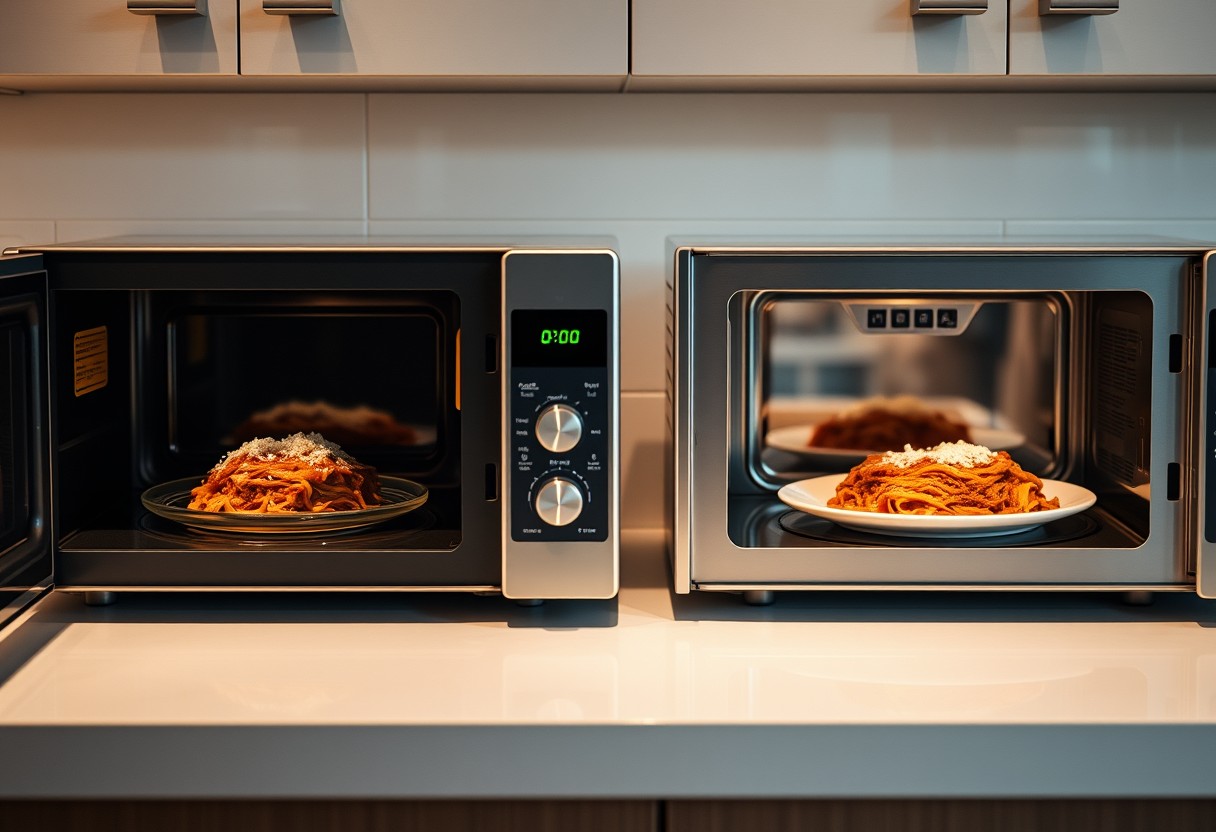
When you double the amount of food in your microwave, cooking time doesn’t double-it increases disproportionately due to how microwaves distribute energy. Your appliance emits a fixed amount of power, so more mass requires more time to absorb sufficient energy. Ignoring this can lead to uneven heating or undercooked food, posing safety risks. You must adjust timing based on quantity, not intuition.
Key Takeaways:
- Microwave ovens deliver a fixed amount of energy per second, so doubling the food means the same energy is spread across more mass, requiring longer cooking times to achieve the same internal temperature.
- Heating in microwaves relies on water molecules absorbing electromagnetic waves; when food quantity increases, the density and distribution of these molecules affect how evenly and quickly heat builds up.
- Unlike conventional ovens, microwaves don’t scale linearly-two portions often need more than twice the time because the outer layers absorb most of the initial energy, leaving the center to heat more slowly through conduction.
The Curious Case of the Domestic Particle Accelerator
Inside your microwave, electromagnetic waves engage directly with water molecules in food, causing them to rotate rapidly and generate heat through molecular friction. You’re not just reheating a meal-you’re orchestrating a controlled interaction between energy and organic matter. The microwave radiation targets polar molecules, making them align and spin with the oscillating electric field. This process heats food from within, but only up to a point-once the wave energy is absorbed or reflected, no further acceleration occurs. The intensity of this interaction depends on the food’s composition, density, and distribution, not just the duration of exposure.
The miracle of the magnetron
Your microwave’s magnetron generates electromagnetic waves at a precise frequency-2.45 GHz-that resonates strongly with water molecules. This component doesn’t amplify its output based on how much food you add; it emits a fixed amount of energy regardless of load size. When you double the food, the same number of waves must now excite twice as many molecules, spreading the available energy thinner. The magnetron’s unchanging power means each molecule receives less rotational push, slowing the overall heating process even if timing stays the same.
Waves that ignore the air
Microwave radiation passes through air almost without interaction, which is why the space inside the cavity doesn’t heat up significantly before the food does. These waves travel unimpeded until they meet polar molecules like those in fats, sugars, and especially water. Once absorbed, their energy converts directly into motion and then heat within the food itself. This selective targeting allows for rapid internal heating while leaving surrounding materials unaffected, but also means energy distribution depends entirely on where the food is-and how much of it is there to absorb the waves.
The Magnetron’s Unyielding Energy Budget
A fixed budget of photons
You receive a constant stream of microwave energy from the magnetron, no matter how much food fills the cavity. This component generates electromagnetic waves at a fixed power output, typically between 600 and 1200 watts, which translates to a strict limit on the number of photons delivered per second. When you double the food, each gram still gets only a fraction of that unchanging energy supply. The microwave doesn’t adjust or increase output-so more mass means less energy per unit, slowing the overall heating process significantly.
Why the box refuses to work harder
Your microwave operates within strict electrical and thermal limits designed for safety and longevity. The magnetron draws power based on its engineered specifications and cannot exceed its maximum wattage, even when confronted with larger loads. Unlike a stove burner that can be turned up, this appliance has no higher setting to tap into. Expecting it to “work harder” would require components capable of handling increased current and heat dissipation-features absent in standard consumer models due to cost, size, and design constraints.
The Perils of Increasing the Culinary Landscape
When you double the food in your microwave, you’re not just adding ingredients-you’re introducing a physical barrier that impedes microwave penetration. Microwaves penetrate food from the outside in, typically reaching only 1 to 1.5 inches deep. As mass increases, inner portions are shielded by outer layers, creating uneven heating patterns. This means cold spots can persist even after extended cooking times. For safety and quality, understanding this limitation is essential, especially when reheating dense or thick foods.
The shadow cast by a second potato
Placing a second potato beside the first might seem harmless, but it fundamentally alters how energy reaches each. Microwaves travel in straight lines and don’t bend around objects, so one potato can cast a “shadow” where waves fail to reach the other. The result? One fully cooked, the other barely warm. You’re no longer just heating food-you’re managing wave distribution. This interference makes uniform results unexpectedly difficult without repositioning or staggering cook times.
Depth and the limit of reach
Microwaves lose energy rapidly as they enter food, with most absorption occurring within the outer inch. When you increase portion size, especially in dense items like meat or potatoes, the core relies on conducted heat from outer layers rather than direct wave exposure. This conduction is significantly slower, leading to prolonged overall cooking needs. Your microwave isn’t underperforming-it’s hitting a physical boundary. Ignoring this depth limit risks serving food that’s overcooked on the edges yet unsafe at the center. Learn more about how these dynamics intersect with nutrition and safety in this detailed analysis: Do Microwave Ovens Affect Food and Our Health Harmfully?.
The Molecular Square Dance of Friction
The frantic vibration of H2O
You feel the heat rise as microwaves penetrate your meal, targeting water molecules embedded throughout. These H2O molecules rotate rapidly, flipping billions of times per second to align with the oscillating electromagnetic field. This frantic motion generates heat through molecular friction, warming the surrounding food. The more evenly distributed the moisture, the more uniform the heating. But if pockets of dryness exist, those areas resist this vibration, leaving you with unevenly cooked results despite the intense internal agitation.
How ice blocks the party
Ice disrupts the microwave’s ability to energize water molecules because its crystalline structure restricts movement. While liquid water spins freely under microwave exposure, frozen water remains locked in place, absorbing energy far less efficiently. This means a frozen portion heats much slower than a thawed one, creating cold spots even after extended cooking. The microwave continues delivering energy, but much of it goes unused until enough ice melts to release molecules into a mobile state, restarting the heating process in earnest.
The Peculiar Arithmetic of the Kitchen Timer
Time in the microwave doesn’t scale linearly with food quantity, and assuming it does lands you in the double-time trap. When you double the portion, you don’t need to double the cooking time because microwaves penetrate food simultaneously, heating multiple layers at once. The magnetron delivers energy at a fixed rate, but thermal distribution depends on mass and density. More food absorbs more total energy, yet the increase needed is partial, not proportional, due to overlapping heat absorption and internal conduction.
Eschewing the double-time trap
You’ve likely added ten extra minutes when doubling a five-minute meal, only to find the edges rubbery and the center still cold. This overestimation stems from treating microwave heating like conventional ovens, where time and volume correlate more directly. Microwaves excite water molecules throughout, so while more food requires more total energy, the difference is modest-typically 1.5 to 1.8 times the original time, not double. Relying on intuition here leads to overcooked edges and wasted energy.
The golden ratio of reheating
A 1.5x multiplier often strikes the ideal balance when doubling portions, especially for moist, evenly shaped foods like rice or stew. This ratio accounts for increased mass without overcompensating for the microwave’s simultaneous energy delivery. Dense or thick items may lean toward 1.7x, while loose or shallow layers might need only 1.3x. The key is incremental testing: pause, stir, reassess. This approach prevents scorching and ensures heat spreads through conduction after the timer stops.

The Virtuous Necessity of Doing Absolutely Nothing
Heat does not vanish the moment the microwave stops; it continues to move, driven by the physics of thermal equilibrium. You benefit from this residual redistribution because the food keeps cooking even when the power is off. This silent phase allows temperature gradients to even out, preventing scalding edges and cold centers. Interrupting this rest period risks uneven results, no matter how precise your timing. Letting dishes sit isn’t passive-it’s an essential part of the cooking process.
Conduction’s slow and steady march
After microwaves cease, heat spreads through the food via conduction, a process governed by molecular contact rather than radiation. This transfer moves at a fixed pace, dependent on the food’s density and moisture content. You cannot rush it-even heat distribution requires time, not energy. Dense portions like the core of a potato or the center of a casserole rely on this quiet period to absorb warmth from hotter outer layers, ensuring thoroughness without overcooking the surface.
The patience required for the center
Temperature lags in the innermost regions of food are inevitable, even after the microwave stops. These zones continue to warm not from new energy input but from inward-moving heat waves generated during active cooking. Your decision to wait allows up to 20% more internal temperature rise without further exposure to microwaves. Skipping this rest means biting into a dish that’s hot on the outside but stubbornly cool at its core-a fixable flaw with nothing more than stillness.
Final Words
You now understand that doubling your food doesn’t simply double the cooking time because your microwave’s energy output remains fixed. The magnetron delivers the same amount of energy regardless of portion size, and more food means more molecules competing for that energy. Heat distribution becomes less efficient, especially in dense or unevenly arranged items, requiring additional time beyond simple arithmetic. Standing time remains just as important, allowing heat to equalize through conduction. You adjust not just for quantity, but for how energy interacts with mass and moisture-physics, not guesswork, guides the clock.
FAQ
Q: Why doesn’t doubling the food simply mean doubling the cooking time in a microwave?
A: Microwaves generate a fixed amount of energy per second, and that energy must be absorbed by the food to generate heat. When you double the quantity of food, you’re not just increasing the mass-the microwaves also have to penetrate deeper and distribute energy across more molecules. Because microwave energy diminishes with depth and isn’t instantly redistributed, the center of a larger portion heats more slowly. This means the relationship between food quantity and cooking time isn’t linear. Simply doubling the time often leads to overcooked edges and a cold center, so adjustments require more than arithmetic.
Q: Do microwaves cook food from the inside out?
A: No, microwaves do not cook food from the inside out. They penetrate food to a depth of about one to one and a half inches, depending on density and water content, heating the outer layers first. The inner portions warm up through conduction, the same way heat spreads in conventional cooking. When you double the amount of food, especially if it’s stacked or densely packed, the microwaves can’t reach the center effectively, making conduction the bottleneck. This is why larger quantities need more time, but not twice as much.
Q: How does the shape and arrangement of food affect microwave heating times when quantity increases?
A: Shape and placement significantly influence how evenly and quickly food heats. Two cups of soup in a single tall container will heat unevenly because microwaves struggle to reach the bottom. Spreading the same amount into a wider, shallower dish exposes more surface area to the waves, improving efficiency. When doubling food, arranging it in a ring shape or stirring midway helps avoid cold spots. A dense block of food traps microwaves on the surface, while a dispersed layout allows deeper penetration and faster overall heating.
Q: Why does my microwave sometimes overheat the edges of doubled portions while the middle stays cold?
A: Microwave energy is absorbed most strongly at the outer edges and corners of food, where exposure is greatest. These areas can absorb energy faster than it can conduct inward, leading to overheating on the surface while the core remains cool. Doubling the food without adjusting the shape or adding pauses for heat to distribute worsens this effect. The phenomenon, known as “edge overheating,” is why many recipes recommend stirring, rotating, or letting food rest after microwaving-especially with larger amounts.
Q: Can the wattage of my microwave change how much extra time I need when doubling food?
A: Yes, wattage directly affects cooking efficiency. A 1,200-watt microwave delivers energy faster than a 700-watt model, so doubling food in a lower-wattage unit may require significantly more than double the original time. For example, a dish that takes 3 minutes in a high-powered microwave might need 7 or 8 minutes when doubled in a weaker one, not just 6. Always check your microwave’s wattage and adjust expectations accordingly. Lower power settings can help by extending time and allowing heat to spread more evenly, reducing the risk of scorching.