You’ve likely pressed the “Power Level” button without fully understanding what it controls. Lower settings don’t reduce heat-they cycle the magnetron on and off, allowing food to cook more evenly. Using high power unnecessarily can scorch edges while leaving centers cold, while too-low settings may leave harmful bacteria thriving in undercooked zones. Knowing when to adjust power helps you retain moisture, avoid explosions, and reheat leftovers like a pro.
Key Takeaways:
- Microwave power levels control the percentage of time the magnetron is active during heating, not the intensity of the waves, allowing food to heat more evenly when lower settings are used.
- High power (100%) works best for boiling water, cooking vegetables, or reheating dense foods quickly, while medium to low settings (30-70%) suit delicate tasks like softening butter or melting chocolate without scorching.
- Using reduced power levels improves defrosting results by giving heat time to spread through frozen food without cooking the outer layers, making it easier to achieve uniform thawing.
The Duty Cycle Secret
Every microwave uses a duty cycle to simulate lower power levels, even though it only operates at full output when active. Instead of reducing energy, your microwave cycles on and off-running at 100% for bursts, then pausing. At 50% power, it’s on half the time and off half the time; at 30%, it’s on for shorter intervals with longer breaks. This cycling prevents constant heat buildup, allowing food to cook more evenly without overcooking edges. Understanding this helps you anticipate how food heats, especially delicate items that need gentle treatment.
Maximum Velocity Cookery
You rely on high power settings when speed is non-negotiable, such as boiling water or cooking raw vegetables quickly. At 100% power, your microwave delivers energy continuously, creating intense heat that penetrates food fast. This setting works best for tasks requiring rapid temperature rise, but overuse can lead to uneven results or scorching. Use full power only when necessary-delicate foods like fish or sauces often suffer under maximum intensity. Timing becomes far more critical here; even 30 seconds too long can turn a good meal into a mess.
The Art of the Simmer
You can gently heat delicate sauces, stews, or dairy-based dishes without scorching or curdling by using 30% to 50% power. At this range, your microwave cycles on and off just enough to maintain slow, even warmth-ideal for keeping food moving without boiling over. Never use high power for custards or cheese sauces; low and slow prevents separation and rubbery textures. For best results, stir occasionally and cover to retain moisture. Learn how to use the right microwave power level to preserve flavor and consistency every time.
Thawing Without Cooking
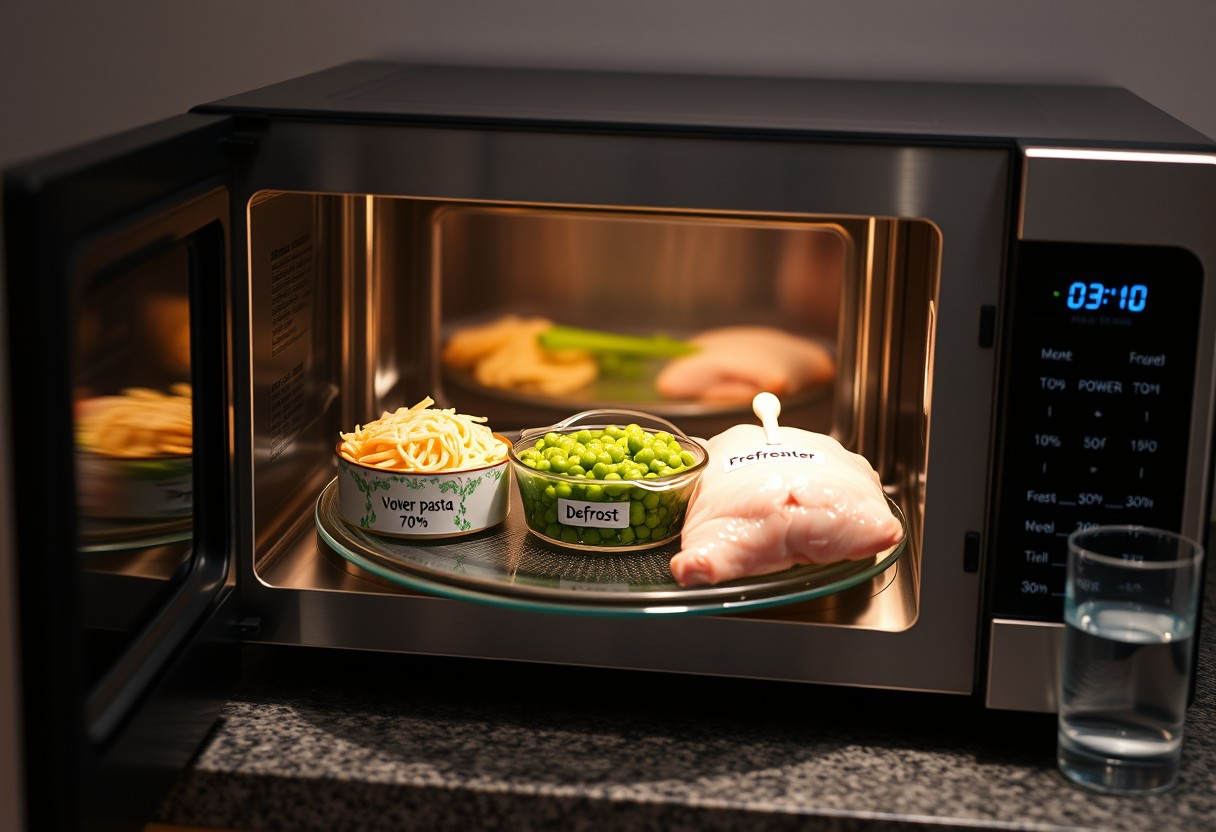
You can prevent the edges of frozen food from cooking while the center remains icy by using a low power setting, typically 30% or “Defrost.” Microwaves cycle on and off during low-power operation, allowing heat time to distribute evenly through the food. This pause between bursts lets warmth travel inward without overcooking outer layers, making it ideal for safely thawing meats, breads, or frozen vegetables. Skipping this step may lead to partial cooking, increasing the risk of bacterial growth once the food reaches danger-zone temperatures. Always rotate or separate pieces midway for consistent results.
The Leftover Restoration
Reheating last night’s dinner without turning it into a rubbery, uneven mess requires more than just pressing the “reheat” button. You need to understand how lower power settings preserve texture while still bringing food up to a safe temperature. At 50-60% power, microwaves cycle on and off just enough to heat leftovers evenly without overcooking the edges. This is especially important for dishes with sauce or moisture, where high power would cause splattering and drying. You’ll find that pasta, rice, and casseroles respond best when heated gradually-ensuring they’re hot throughout but still retain their original consistency.
To wrap up
You now understand that microwave power levels control the intensity of energy pulses, not the temperature itself. By adjusting these levels, you gain precise control over how food cooks, thaws, or reheats. Using lower settings prevents rubbery leftovers, uneven defrosting, or boiled edges on delicate foods. High power works best for speed, while medium to low settings improve results for sensitive tasks. You make the difference by choosing the right level at the right time, turning a simple appliance into a more effective kitchen tool.
FAQ
Q: What do microwave power levels actually control?
A: Microwave ovens use power levels to adjust the duty cycle-the pattern of when the magnetron (the part that generates microwaves) turns on and off during cooking. At 100% power, the magnetron runs continuously. At lower settings like 50%, it cycles on and off, operating at full power during the “on” periods but pausing periodically. This creates an average reduction in energy delivery, allowing food to heat more gradually without constant intense radiation.
Q: When should I use 100% power on my microwave?
A: Full power works best for tasks requiring speed and high heat, such as boiling water, steaming vegetables, or reheating beverages. It’s also effective for quickly cooking foods with high moisture content that respond well to direct energy, like leftover soups or stews. Dense or thick items may still need stirring even at full power to avoid uneven heating.
Q: Can I cook meat using lower power settings?
A: Yes, lower power levels like 50-70% help cook meat more evenly without overcooking the outer layers. For example, a chicken breast heated at 100% often becomes rubbery on the edges while staying cold in the center. Using 60% power extends the cooking time slightly but allows heat to penetrate deeper before the surface dries out, preserving texture and moisture.
Q: Why does my food sometimes cook unevenly even after using a lower power setting?
A: Uneven cooking can occur due to irregular shapes, varying food densities, or lack of rotation. Microwaves naturally create hot spots inside the cavity, so even with reduced power, certain areas absorb more energy. Stirring, rotating, or letting food stand after microwaving helps distribute heat. Placing items like potatoes or dumplings in a circle instead of a pile also improves consistency.
Q: Is defrosting better at low power, and if so, which level should I use?
A: Defrosting works best between 30-50% power because it gives time for ice crystals to melt without activating the cooking process. A frozen steak warmed too quickly develops cooked patches along the edges while remaining solid inside. At 30%, the microwave delivers brief bursts of energy, letting heat spread inward slowly. Many microwaves have a dedicated defrost button calibrated to this range, often based on weight.