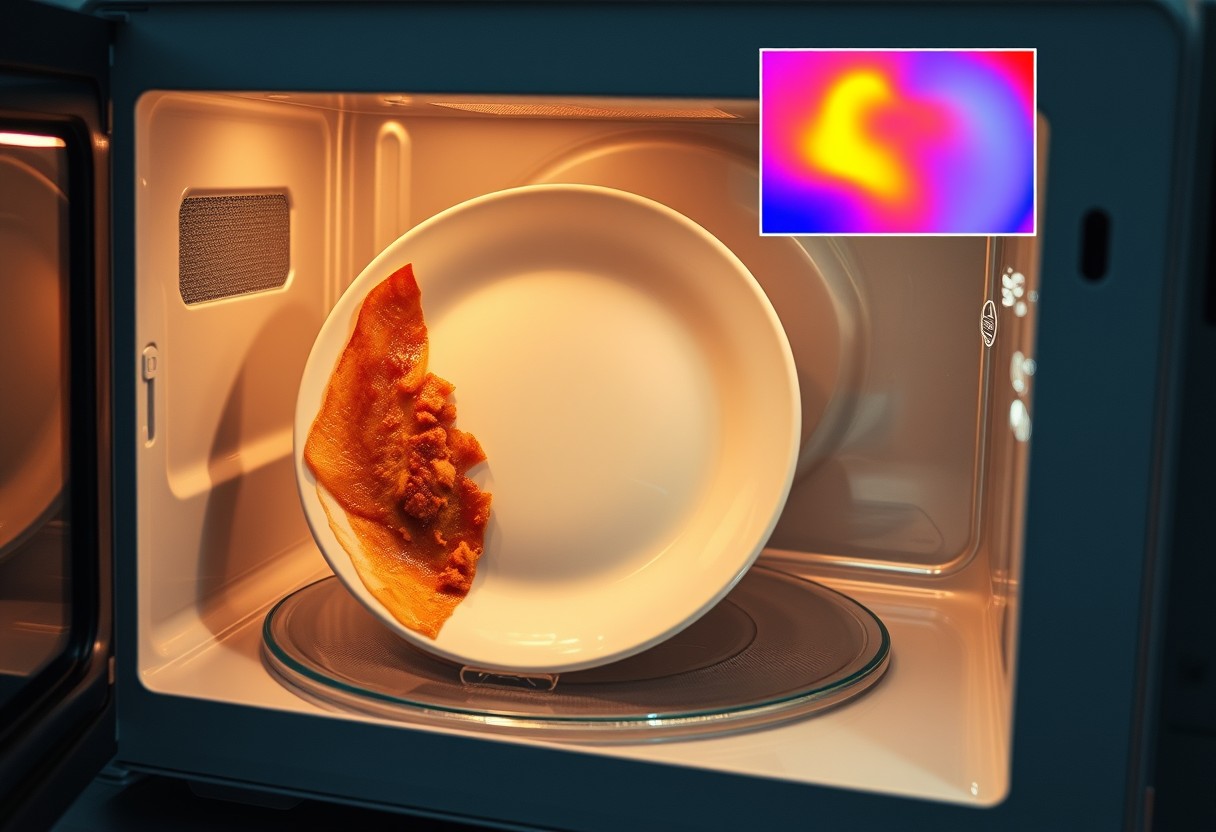
You’ve likely noticed one side of your leftovers scalding hot while the other remains cold-this uneven heating is caused by how microwaves distribute energy inside the cavity. Microwave radiation forms standing waves, creating hot and cold spots, and your food sits directly in this inconsistent field. Ignoring this can lead to undercooked, potentially unsafe meals, especially in dense or large portions. You can manage this effect with simple strategies.
Key Takeaways:
- Microwave ovens heat food using electromagnetic waves that create hot and cold spots due to wave interference, leading to uneven cooking-often leaving one side of the food warmer than the other.
- The turntable helps reduce uneven heating but can’t fully compensate for dead zones in the microwave’s energy distribution, especially when food is dense or irregularly shaped.
- Food composition matters: areas with higher water, fat, or salt content absorb microwave energy more quickly, causing localized overheating while drier sections remain cool.
The Hidden Topography of the Kitchen Box
Inside your microwave, electromagnetic waves don’t spread evenly-they reflect off metal walls and form a fixed pattern of high and low energy zones. You’re not imagining it when one bite of your meal scalds your tongue while the next feels cold; this unevenness stems from the wave interference created within the cavity. The result is a static landscape where hotspots and cold spots remain in place, regardless of how long you run the timer.
The Static Landscape of Radio Waves
Radio waves bounce unpredictably inside the metal enclosure, but their behavior isn’t random-it’s governed by precise physics. These reflections create standing waves, patterns that stay fixed in space as long as the microwave’s structure remains unchanged. You experience these as consistent hot zones, often near the center or edges depending on your model’s design. Even slight changes in food placement can shift exposure from peak to null, making heating outcomes feel unreliable despite consistent settings.
Mapping the Peaks and Valleys of Energy
Engineers use thermal paper and moisture grids to visualize where energy concentrates during operation, revealing a distinct map of intensity across the turntable. These tests consistently show that peaks of microwave energy can be two or three times stronger than adjacent valleys. Your food passes through these zones as it rotates, but if rotation is limited or food is oversized, parts may never reach a high-energy area, leaving them underheated no matter the cook time.

The Frenetic Shaking of the Water Molecule
Every time you press start, microwave energy penetrates your food and targets molecules of water, forcing them to vibrate at extreme speeds. This rapid oscillation creates friction, which in turn produces heat from within the food itself. You’re not just warming leftovers-you’re setting off a microscopic storm where water molecules twist and collide, turning electromagnetic waves into thermal energy. The uneven distribution of moisture means some areas heat faster, especially where water is more concentrated. Why does a microwave heat soup at the edges before … becomes clearer when you see how this energy interacts with liquid-rich zones first.
The Violent Agitation of Tiny Particles
Water molecules are electric dipoles, meaning they have a positive and a negative end, and they spin rapidly as the microwave’s alternating electric field flips direction billions of times per second. This violent agitation generates intense localized heat wherever water is present, especially near the surface where energy absorption peaks. You might notice sauces or wet ingredients scalding while drier parts remain cool-this happens because only molecules with enough polarity respond strongly to the radiation, leaving starches or fats largely unaffected until heat slowly transfers.
Why Ice Refuses to Join the Party
Frozen water molecules are locked in a rigid crystalline structure, unable to rotate freely like their liquid counterparts. Microwaves struggle to make ice vibrate efficiently because the molecules can’t keep up with the rapidly changing field. That’s why a frozen meal often has scalding hot spots next to icy patches. The microwave energy bypasses solid ice, preferentially heating any small pockets of liquid water that have already melted, creating an uneven cooking experience until enough heat builds to thaw the entire portion.
The Merry-Go-Round that Doesn’t Quite Work
Your microwave’s spinning plate was designed to solve a core problem: uneven energy distribution. As the turntable rotates, it drags your food through hot and cold zones created by standing waves inside the cavity. While rotation helps, it can’t fully compensate for how deeply microwaves penetrate or where they concentrate. The result? Some areas absorb more energy, while others barely warm up. This constant movement is an imperfect fix-your meal passes through intense fields at inconsistent angles, leaving parts overcooked and others cold.
The Struggle to Find a Hot Spot
Each rotation shifts your food into new pockets of microwave energy, but timing and position matter more than motion alone. Microwaves form standing wave patterns with peaks of high intensity and valleys of near-nothingness. When your dish lands in a low-energy zone during part of its spin, that section heats minimally. You’re not just relying on movement-you’re gambling on alignment. Even slight differences in starting position can leave one edge steaming while the opposite stays chilled, despite full revolutions.
The Cold Heart of the Burrito
A tightly rolled burrito often emerges with a scalding exterior and a center as cold as when it went in. Rotation moves the outer layers through hot spots, but the dense core lags behind in thermal response. Microwaves lose strength as they penetrate, so deeper regions receive less energy even when perfectly aligned. The spin keeps the surface cycling through heat, but internal conduction can’t keep pace. You end up with a deceptive crust of warmth hiding a refrigerated core, no matter how many seconds you added.
The Architectural Failures of Your Dinnerware
Your plate isn’t just a stage for presentation-it actively shapes how microwaves move through your meal. Flat-bottomed bowls and square containers create predictable reflection patterns that concentrate energy in certain zones, leaving others untouched. The shape of your dish determines where waves converge, and sharp angles often become hotspots due to intensified wave clustering. Even slight variations in curvature can redirect energy away from the center, meaning your food’s fate is largely sealed the moment you choose the container.
Why Corners Are a Recipe for Overcooking
Corners act like microwave magnets, pulling energy into tight zones where waves bounce and叠加 repeatedly. When your lasagna’s edges turn rubbery while the center stays cool, it’s not poor timing-it’s geometry working against you. The intersecting walls of a square dish reflect waves inward, causing them to collide and amplify heat in the corners. You’re not overcooking by mistake; you’re witnessing physics exploit the weakest structural points of your container.
The Strange Geometry of Wave Reflection
Every curve and edge on your dish bends microwave paths in unexpected ways, often sending energy into unintended pockets. A slightly concave plate may focus waves like a lens, while ridges or embossing scatter them unpredictably. These reflections don’t follow a uniform pattern, leading to chaotic clustering that favors no logic you can see. What looks like a simple plate is actually a complex field of invisible wave redirection, silently deciding which bite will scald and which will chill.
The Limited Ambition of the Microwave Beam
Microwave energy doesn’t cook your food from the inside out, no matter what the myths claim. Instead, it penetrates only a few centimeters into most foods, with the outer layers absorbing the majority of the radiation. This shallow reach means the center of thicker dishes relies on heat spreading inward through conduction, just like in conventional cooking. If the microwave beam could dive deeper, hotspots and cold zones would be far less common.
The Shallow Reach of Invisible Rays
Your microwave emits electromagnetic waves that typically penetrate just 1 to 1.5 inches into food, depending on density and moisture. Beyond this depth, the energy fades rapidly, leaving inner portions untouched by direct radiation. This limited penetration explains why dense items like meatloaf or baked potatoes often have cold centers despite extended cook times. The outer shell absorbs most of the energy, while the core waits for slow thermal diffusion.
Why You Are Actually Eating Conducted Heat
You’re not tasting microwaves-you’re tasting heat passed from molecule to molecule after the initial energy burst. Once the outer layer absorbs microwave energy and heats up, it warms adjacent cooler regions through conduction, much like a steak seared on a skillet. This process is significantly slower than the rapid agitation of water molecules near the surface. As a result, uneven temperatures persist unless you allow standing time for heat to naturally even out through the food’s interior.
Summing up
You experience uneven heating in your microwave because microwaves emit energy from one direction and create hotspots where waves intersect with food. Your food’s shape, density, and composition affect how deeply and evenly those waves penetrate. The turntable helps but can’t fully compensate for shadowed areas or thick sections that block energy. Materials like ceramic or plastic containers may insulate or redirect heat unpredictably. You’re not doing anything wrong-your microwave was built with inherent limitations in wave distribution and cavity design that simply don’t deliver uniform cooking without strategic pauses or repositioning.
FAQ
Q: Why does my microwave heat food unevenly, with one side hotter than the other?
A: Microwaves use electromagnetic waves that bounce around the interior cavity, creating hot and cold spots due to wave interference. These waves tend to concentrate in certain areas, often leading to one side of the food absorbing more energy. The position of the food, the shape of the container, and the density of the food itself all influence how evenly it heats.
Q: Can the turntable in my microwave prevent uneven heating?
A: The turntable helps by rotating food through different areas of the microwave cavity, exposing it to varying wave intensities. However, if the turntable is obstructed, too slow, or the food is large or irregularly shaped, some parts may still receive more energy than others. Even with rotation, complete uniformity is difficult because of how microwaves interact with different food compositions.
Q: Does the shape and depth of my container affect heating patterns?
A: Yes. Round or oval containers allow microwaves to circulate more evenly around the food, while square or rectangular dishes can create corners that absorb excess energy, leading to overheating in those spots. Deep containers may shield the lower layers from direct exposure, leaving the center or bottom cooler even if the top edges are scalding.
Q: Why does dense food like meat heat unevenly compared to something like soup?
A: Microwaves penetrate food from the outside in, typically reaching only about one to one and a half inches deep. In dense foods like chicken or potatoes, the outer layers absorb most of the energy, while the center relies on slow thermal conduction to warm up. Liquids like soup heat more uniformly because heat distributes quickly through convection, reducing cold spots.
Q: Can stirring or rearranging food during microwaving improve results?
A: Stirring or rotating food halfway through cooking moves cooler portions into areas that have been more exposed to microwave energy. This simple step can significantly reduce uneven heating. For solid items like casseroles or baked potatoes, cutting them into smaller, uniform pieces before heating also promotes more consistent results.