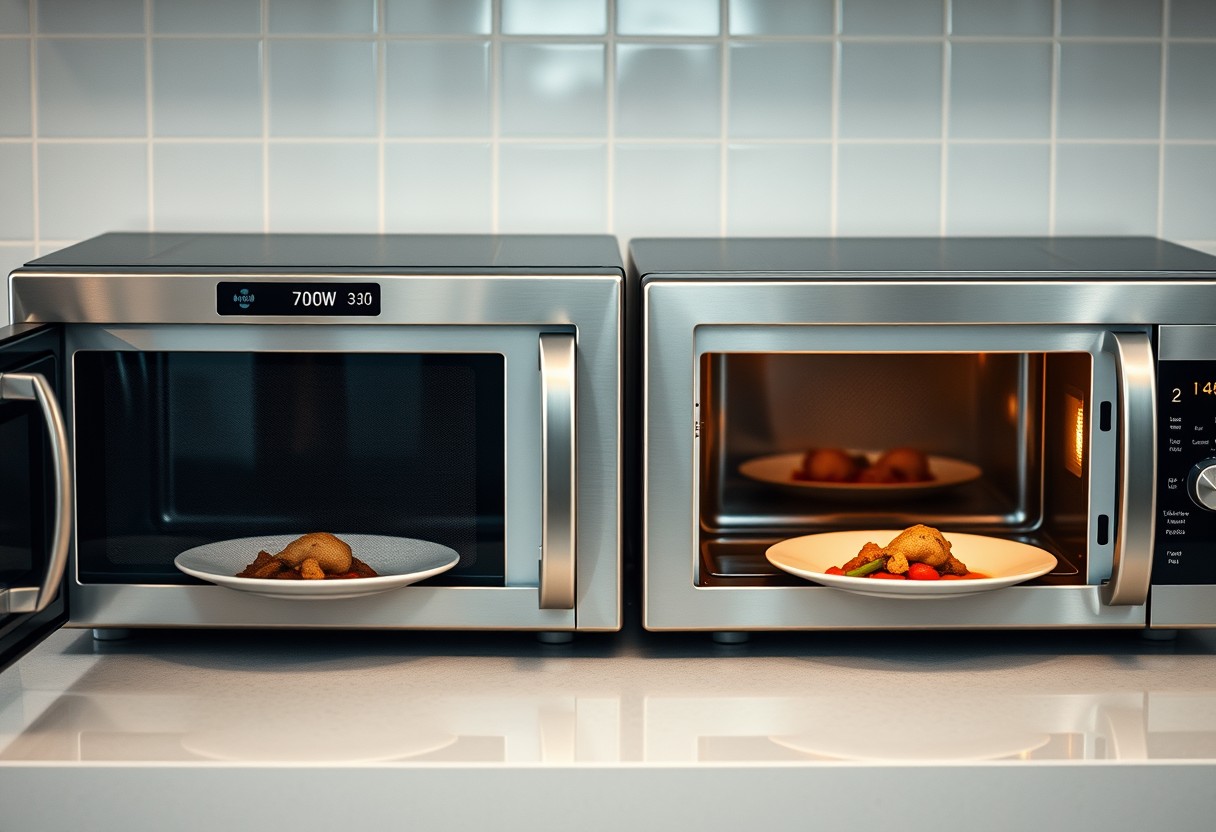
You’ve probably noticed that your microwave heats food faster than your friend’s, even when using the same settings. The reason lies in microwave wattage, a number that directly affects cooking time and results. A lower-wattage model may take up to twice as long to heat the same dish, leading to undercooked meals if you don’t adjust. Understanding your microwave’s power helps avoid dangerous cold spots in food and ensures consistent, safe results every time.
Key Takeaways:
- A microwave’s wattage directly affects cooking time-higher wattage models heat food faster because they deliver more energy per second, while lower wattage units require longer cycles to achieve the same results.
- Most packaged foods are tested and timed using a standard 800-1,000 watt microwave, so using a microwave outside that range without adjusting the time often leads to undercooked or overheated meals.
- Real-world performance can vary even among microwaves with the same labeled wattage due to factors like age, magnetron efficiency, and duty cycle, meaning two 900-watt models might not cook identically.
The Anatomy of the Magnetron
At the heart of your microwave lies the magnetron, the component responsible for generating electromagnetic waves that heat food. This small but powerful device converts electrical energy into microwave radiation, and its rated output directly determines the appliance’s wattage. You can think of wattage as a measure of how much raw energy your microwave can produce per second. Higher-wattage models deliver more intense bursts of energy, leading to faster cooking times. The magnetron’s efficiency in this conversion process defines how quickly your leftovers go from cold to steaming.
Defining the Watt as Work
A watt measures the rate at which energy is used or transferred, defined as one joule of work per second. When you see a microwave labeled 1000 watts, it means the magnetron can generate that amount of power under ideal conditions. Your cooking time depends directly on this number-higher wattage means more energy delivered to your food in less time. If you’re reheating soup, a 1200-watt unit will finish significantly faster than a 700-watt model because it performs more work each second.
Energy Conversion and Waste Heat
Not all electricity drawn by your microwave becomes useful cooking energy. The magnetron generates substantial waste heat during operation, a natural byproduct of converting household current into microwaves. While the device might pull 1500 watts from the outlet, only about 60-70% of that becomes actual microwave output-the rest dissipates as heat or powers internal components. This inefficiency means two microwaves with the same input power can have different cooking strengths based on how well they manage thermal loss.
The Geometry of the Box
Your microwave’s interior isn’t just a metal box-it’s a resonant cavity where electromagnetic waves bounce unpredictably. The shape and size of this cavity influence how microwaves reflect and interact, creating zones of high and low energy. Without intervention, these patterns lead to dangerous cold spots where food remains undercooked. Even with a stirrer fan distributing waves from the top or side, wave interference can leave certain areas consistently cooler, especially in corner regions or near the walls where reflection is most intense.
Interference Patterns and Cold Spots
Waves reflecting off metal surfaces can amplify or cancel each other depending on their alignment. When peaks meet peaks, energy intensifies; when peaks meet troughs, they nullify, forming cold spots that fail to heat food properly. These interference patterns are predictable in physics but chaotic in practice due to the microwave’s fixed dimensions and frequency. You’ve likely seen this when part of your meal is scalding while another remains icy-proof of how wave behavior directly impacts cooking outcomes inside the cavity.
The Mechanical Solution of the Turntable
A rotating turntable moves your food through varying energy zones, averaging out exposure over time. Instead of relying on perfect wave distribution-which is physically unattainable-this simple motion ensures each section of your meal passes through hot and cold regions. The result is more even heating despite the microwave’s inherent electromagnetic inconsistencies. If your turntable stops working, you’ll notice dramatic differences in texture and temperature, underscoring how essential this mechanical fix is to everyday performance.
The Agitation of the Molecule
Water molecules in your food respond directly to microwave energy through a process called dipole rotation. When microwaves penetrate your meal, they create an alternating electromagnetic field that causes polar water molecules to rapidly spin and align themselves with the changing field. This motion generates heat through molecular friction, and the more moisture-rich the food, the faster it heats. You can learn more about how this interacts with your appliance’s power output at What is wattage? How do I find the wattage of my microwave?, where wattage determines how intensely those waves are emitted.
Exciting the H₂O Molecule
Microwave energy specifically targets hydrogen and oxygen dipoles within water, making foods with high water content heat much faster than dry ones. As the electromagnetic field shifts direction billions of times per second, each H₂O molecule attempts to realign, creating internal kinetic energy. This rapid movement translates into thermal energy, and you’ll notice soups or vegetables steam quickly while breads or crackers risk burning due to uneven excitation. The efficiency of this process depends entirely on how many free water molecules are present to absorb the radiation.
Thermal Conductivity in Dense Solids
Dense foods like meat or potatoes heat less evenly because microwaves penetrate only about one to two centimeters into the surface. Beyond that, conduction must transfer heat inward, which happens slowly compared to direct microwave absorption. While outer layers absorb energy and warm quickly, the center relies on gradual thermal diffusion, often leaving cold spots if not allowed to rest. This delayed conductivity means even high-wattage microwaves can’t instantly heat thick, dense items uniformly, requiring strategic pauses or lower power for thorough results.
The Calculus of the Kitchen
Matching cooking times across microwaves isn’t guesswork when you understand output differences. Your microwave’s wattage directly determines how fast energy reaches the food, so a 1,000-watt unit heats significantly faster than one rated at 700 watts. Ignoring this difference can lead to undercooked meals or overheated containers. By applying a simple mathematical adjustment, you can replicate results no matter the machine. The key lies in recalculating time proportionally, ensuring consistent outcomes without trial and error.
The Basic Ratio Formula
Using the ratio of your microwave’s wattage to the recipe’s specified wattage gives you an exact time adjustment. If a dish requires 5 minutes in a 1,000-watt microwave but yours is 800 watts, divide 1,000 by 800 and multiply by 5, resulting in 6.25 minutes. This calculation prevents undercooking while maintaining texture and safety. You’re not adding extra heat-you’re compensating for lower intensity with more time, keeping results reliable and predictable across different models.
Compensating for Low-Power Units
Low-wattage microwaves, often below 700 watts, demand longer exposure to achieve the same thermal effect. When using one, expect to increase cook times by 30% to 50%, depending on the original power reference. Failing to adjust adequately risks uneven heating and cold spots that may harbor harmful bacteria. Stirring food midway and covering it to retain steam helps offset slower energy delivery, but the foundational fix remains accurate time extension based on wattage ratios.
The Secret of the Duty Cycle
Modern microwaves rarely operate at full power continuously, even when set to high. Instead, they use a technique called duty cycling, where the magnetron pulses on and off in timed intervals. You’ll notice this when your microwave hums, stops, then hums again during cooking. This intermittent power delivery prevents overheating one area while leaving another cold, promoting more uniform results. Always allow the full cycle to complete before checking food, and never bypass safety interlocks to access internal components while powered.
The Pulse Method of Thermal Control
When you select a lower power setting, your microwave doesn’t reduce energy output-it cycles the magnetron off for short periods. For example, at 50% power, the unit runs at full wattage for five seconds, then shuts off for five. This pulsing allows heat to diffuse between bursts, reducing hotspots and improving consistency. You benefit from more predictable results, especially with delicate foods like custards or cheese sauces that can scorch under constant energy.
The Importance of Carryover Cooking
Heat continues to migrate through food even after the microwave stops, a process known as carryover cooking. Dense items like potatoes or thick stews can rise in internal temperature by several degrees during standing time. Ignoring this phase leads to overcooked edges or underdone centers. Always follow recommended resting periods after heating to ensure even doneness and safe internal temperatures throughout the dish.

Summing up
You now understand that microwave wattage directly affects how quickly your food heats. A 700-watt model requires more time than a 1200-watt unit because it delivers energy at a slower rate. Your experience with uneven or prolonged heating often comes down to this difference in power output. Manufacturers build microwaves with varying duty cycles and cavity designs, further influencing results. You can adjust cooking times based on your appliance’s rated wattage, ensuring more consistent outcomes. Matching the microwave to your needs improves everyday efficiency.
FAQ
Q: Why does my microwave cook food faster than my friend’s, even though we use the same settings?
A: Microwave cooking speed depends primarily on wattage. Most household microwaves range from 600 to 1200 watts. A 1000-watt model heats food significantly faster than one rated at 700 watts. If your microwave has higher wattage, it delivers more energy per second to the food, reducing cooking time. Two people following the same instructions will see different results unless they adjust for their appliance’s power.
Q: How can I find out the wattage of my microwave?
A: The wattage is usually listed on a sticker inside the door frame, on the back of the unit, or in the user manual. If it’s not visible, you can perform a simple water test. Fill a microwave-safe cup with exactly 8 ounces of room-temperature water and heat it on high. If it takes about 2 minutes to boil, your microwave is around 600-700 watts. A 1-minute boil suggests 1000 watts or more. This gives a rough estimate when specifications are missing.
Q: Do lower-wattage microwaves cook food unevenly?
A: Not necessarily due to wattage alone, but lower-powered units often lack advanced features like inverter technology or turntables, which contribute to even heating. A 700-watt microwave may take longer and require manual rotation of food, while a 1000-watt inverter model adjusts power smoothly, reducing cold spots. The combination of wattage, cavity design, and stirring mechanisms determines uniformity, not power output by itself.
Q: Can I adjust cooking times for different microwave wattages?
A: Yes, you can scale cooking times using a basic formula. Divide the wattage of the recipe’s reference microwave by your microwave’s wattage, then multiply that ratio by the original time. For example, if a recipe assumes a 1000-watt microwave and you have a 700-watt model, multiply the time by (1000 ÷ 700) ≈ 1.43. So 2 minutes becomes about 2 minutes and 52 seconds. This helps standardize results across different machines.
Q: Why do some microwaves say they’re 1000 watts but seem weaker than others with the same rating?
A: Advertised wattage typically refers to peak output, not sustained power. Some models use short bursts of full power separated by pauses, especially non-inverter microwaves, which cycle on and off to simulate lower settings. Two 1000-watt microwaves may deliver energy differently-one with steady output, another with intermittent bursts-leading to perceived differences in strength. Build quality, magnetron efficiency, and cavity reflectivity also affect real-world performance.