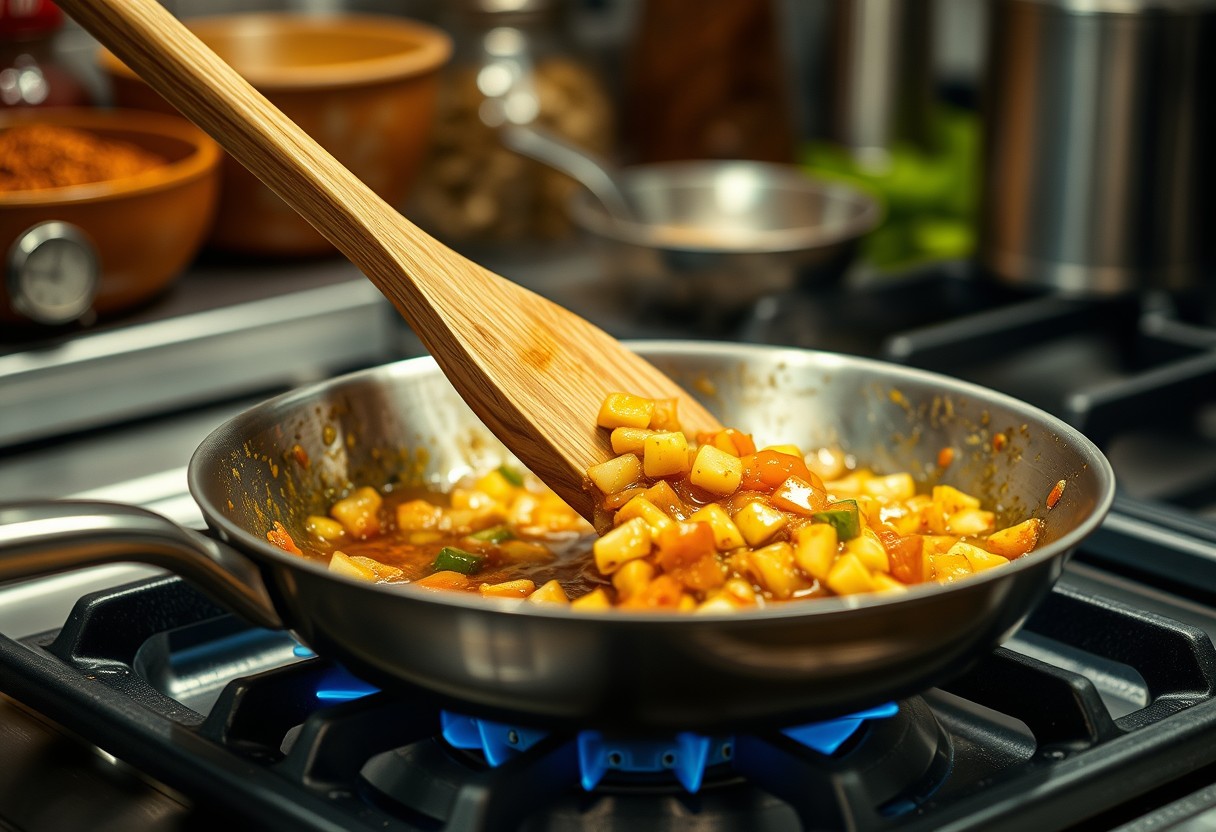
You’ve likely stirred a pot without thinking, but that simple motion does far more than mix ingredients. Uneven heat distribution can lead to undercooked centers and burnt edges, compromising both safety and flavor. Stirring midway corrects thermal imbalances, ensures consistent texture, and prevents dangerous hotspots-especially in dense or sugary mixtures. It’s not just habit; it’s science in action.
Key Takeaways:
- Heat distribution in most cooking environments is uneven, and stirring redistributes hotter outer layers into the cooler center, promoting consistent doneness throughout the dish.
- Foods like sauces, grains, and stews release starches and proteins that can settle or clump; stirring interrupts this process, maintaining a smooth, uniform texture.
- Without intervention, moisture evaporates unevenly and solids begin to burn on contact surfaces-stirring prevents localized overcooking and extends the window for optimal results.
Thermal Dynamics and the Convection Gap
Heat transfers through your food primarily via conduction and natural convection, but these processes often leave cold spots due to uneven energy distribution. Without intervention, denser regions absorb heat more slowly, while outer layers overcook. You must stir to disrupt this imbalance, ensuring thermal energy spreads uniformly throughout the dish. The stagnant boundary layer that forms around ingredients traps cooler mass, slowing cooking-manual stirring breaks this barrier, restoring flow and promoting consistent results across every bite.
Breaking the Boundary Layer
A thin film of cooler liquid surrounds each ingredient during heating, resisting efficient energy transfer. This boundary layer insulates food from the hotter surrounding medium, creating pockets where cooking lags significantly behind visible surface changes. When you stir, you physically dismantle this insulation, exposing fresh surfaces to higher-temperature fluid. This action resets the thermal gradient, accelerating heat penetration and reducing overall cooking time while minimizing texture inconsistencies caused by delayed internal doneness.
Achieving Kinetic Equilibrium
Molecules in a pot are constantly in motion, but their speeds vary widely without mixing, leading to zones of excessive agitation and others with near-stagnant conditions. Stirring redistributes momentum, helping the system approach kinetic equilibrium where energy is more evenly shared among particles. You create this balance manually, preventing localized overheating and ensuring all components respond uniformly to applied heat. The result is a predictable, repeatable cooking curve that supports precision in both timing and texture development.
Atmospheric Regulation and Surface Integrity
Stirring alters the microclimate above and within your food, directly influencing how moisture escapes and proteins behave at the surface. When left undisturbed, a concentrated layer of vapor builds up, trapping heat and encouraging the formation of a tough, often undesirable protein matrix or skin-especially in dairy-based or egg-heavy mixtures. By introducing motion, you disrupt this stagnant atmosphere, allowing for more uniform evaporation and preventing the creation of a leathery film that can compromise texture and mouthfeel.
Preventing the Protein Matrix
You interrupt early-stage protein coagulation every time you stir a simmering custard or risotto. Without agitation, proteins like casein or albumin migrate to the surface, bond tightly under heat, and form a rigid network that resists integration. This skin not only detracts from smoothness but can also shield underlying layers from even cooking. Your consistent movement keeps these proteins dispersed, ensuring they set uniformly rather than creating a stubborn, rubbery barrier on top.
Controlled Evaporation Rates
Heat drives water to escape as steam, but unchecked, this process becomes uneven and unpredictable. When you leave food unstirred, vapor concentrates in specific zones, accelerating drying at the surface while deeper layers remain overly moist. Stirring resets this imbalance by exposing new layers gradually, promoting a steadier release of moisture. This action prevents premature thickening or clumping and maintains a silky, cohesive consistency that’s difficult to achieve otherwise.
Preventing the Carbonization of Solids
Stirring halts the rapid breakdown of dense starches pressed directly against a heat source, where temperatures often exceed the threshold for carbonization. When left undisturbed, these solids undergo pyrolysis-transforming into charred remnants that introduce bitter compounds and potential carcinogens into your dish. You’re not just avoiding a burnt taste; you’re actively preventing the formation of harmful byproducts. This is especially critical with high-heat cooking methods like sautéing or searing, where contact zones can become hotter than intended. Movement disrupts this destructive cycle, preserving both flavor and safety.
The Gravity Trap
Gravity pulls heavier particles to the bottom of your pan, trapping them in the hottest zone where scorching happens fastest. Without intervention, these settled bits-especially from starchy foods like potatoes or grains-overheat and blacken within minutes. You might not notice it immediately, but once carbonization begins, it spreads quickly. By stirring at intervals, you lift these vulnerable pieces from the danger zone, giving them space to cook evenly instead of burning. This simple action prevents unrecoverable damage to texture and taste.
Rescuing the Fond
Fond-the rich, browned layer that forms on the pan’s surface-can easily cross the line from flavorful to foul when overheated. While fond enhances depth, allowing it to remain stagnant leads to carbonization rather than caramelization. When you stir, you incorporate this developing fond into the mixture before it turns acrid. The result is a more balanced, complex taste without the risk of harsh, burnt notes. Your spoon becomes a rescue tool, salvaging flavor potential just before it slips into ruin.
The Mechanics of Molecular Mingling
Stirring reshapes how ingredients interact on a molecular level, ensuring substances like salt and fat disperse evenly throughout your dish. Without agitation, solutes concentrate in pockets, leading to uneven flavor and texture. You’ve likely tasted the result-bitterness in one bite, blandness in the next. Movement breaks these imbalances, promoting uniformity from edge to center. For deeper insights into timing techniques, check out this discussion on how do you manage timing when you cook?, where home cooks share practical approaches.
Solute Distribution and Salt Brines
Dissolved salt migrates slowly through food, relying on physical motion to spread beyond surface layers. When you stir, you actively accelerate diffusion, preventing under-seasoned zones and avoiding sudden bursts of salinity in localized areas. In aqueous environments like soups or brines, stillness creates gradients-regions of high and low concentration-that only mixing corrects. Your consistent movement ensures every molecule has the chance to travel, resulting in a balanced, predictable taste that builds with each bite rather than surprises.
Emulsification and Lipid Suspension
Fat naturally separates from water-based components without intervention, disrupting mouthfeel and consistency. As you stir, you force oil and liquid into temporary alliance, creating a smoother texture and preventing greasy pools or watery streaks. This mechanical action disperses lipids evenly, enhancing both flavor delivery and visual appeal. Even in unstable emulsions like vinaigrettes or pan sauces, brief but deliberate mixing improves cohesion, giving you greater control over the final structure of your dish.
The Microwave Radiation Dilemma
Electromagnetic waves inside your microwave don’t distribute evenly, forming patterns that leave some areas of food cold while others overheat. These wave interferences create zones where energy peaks and nulls occur, making consistent cooking impossible without intervention. Since the appliance can’t adjust its radiation in real time, you must physically reposition the food to balance heat exposure. Only manual stirring disrupts these fixed patterns, ensuring all parts receive adequate energy. Without this step, you risk consuming undercooked or dangerously hot sections.
Nodal Points and Standing Waves
Your microwave generates standing waves as radiation bounces between metal walls, creating stationary points of high and low energy known as nodes and antinodes. At nodal points, minimal heating occurs, leaving pockets of food barely warmed despite extended cook times. These invisible patterns remain fixed unless disrupted, meaning certain spots on your plate consistently miss peak energy exposure. Stirring relocates food through these zones, allowing cooler portions to reach antinodes where heating is strongest, ultimately evening out the temperature across the dish.
Preventing Superheated Pockets
Liquids and dense foods can develop superheated zones where localized temperatures exceed boiling point without visible signs of bubbling. These unstable pockets may erupt suddenly when disturbed, posing a serious burn hazard. Uneven wave concentration enables this dangerous condition by rapidly energizing isolated regions while surrounding areas stay cool. You prevent scalding accidents by stirring midway, which redistributes heat and releases built-up energy safely. This simple action stabilizes internal temperatures and eliminates hidden hotspots before they become a threat.
To wrap up
You stir food midway through cooking because it actively corrects uneven heat distribution, ensuring every part of the dish reaches consistent doneness. Without intervention, pockets of undercooked or overexposed ingredients develop, especially in dense or layered preparations. Turning or mixing redistributes moisture, slows surface drying, and supports even flavor development. In microwave cooking, stirring counteracts standing wave patterns that leave cold spots. You maintain control over texture and safety simply by breaking stillness at the right moment. That brief action bridges the gap between passive heating and reliable results.
FAQ
Q: Why does stirring food halfway through cooking make such a difference in the final result?
A: Heat distribution inside ovens, pans, and microwaves is rarely uniform. Without intervention, some parts of the food absorb more energy than others, leading to uneven textures-overcooked edges with raw centers. Stirring redistributes position and temperature across all components, allowing each portion equal exposure to heat. A casserole stirred once at the midpoint spends less time developing dry patches and maintains consistent moisture from edge to center.
Q: Does stirring apply to baked dishes like casseroles or lasagnas that aren’t typically mixed during cooking?
A: Most baked dishes rely on slow conduction and ambient heat, which creates layered gradients-top layers dehydrate while bottom layers steam. While full stirring isn’t practical for structured dishes, rotating the dish halfway helps counteract hot spots from oven elements. For recipes with loose fillings, like vegetable bakes or grain-based casseroles, gently shaking or nudging the dish can simulate mixing without breaking structure, encouraging even settling and heat penetration.
Q: Can skipping a stir lead to burning even if the temperature seems correct?
A: Yes. Even at moderate settings, localized heat buildup occurs where food contacts metal surfaces directly. Proteins and starches begin to bond with the pan almost immediately, forming a layer that insulates the surface underneath. Once this layer overheats, it carbonizes quickly while the rest of the dish lags behind. A single stir disrupts this process, lifting scorched-prone sections away from direct contact and replacing them with cooler material from above.
Q: Is there a difference between stirring early versus midway through cooking?
A: Timing affects both texture and chemical development. Stirring too early can break apart delicate structures before they set, such as scrambled eggs or risotto grains absorbing liquid. Waiting until the midpoint allows initial searing or gelatinization to occur, preserving body and flavor depth. At that stage, stirring integrates the developed outer layers into the core, balancing doneness without sacrificing integrity. Risotto stirred only at five-minute intervals develops creaminess far more effectively than one disturbed constantly.
Q: How does stirring impact microwave cooking compared to stovetop methods?
A: Microwaves excite water molecules primarily near the surface and in dense clusters, often leaving cold zones in thick foods. Unlike stovetops that heat from below, microwaves create unpredictable hot pockets. Stirring halfway pulls inner mass outward and exposes underheated portions to active zones. A bowl of soup heated without stirring might boil on top while remaining chilled at the base. One thorough mix at the midpoint evens out temperatures rapidly, cutting total cook time and eliminating the need for extended reheating cycles.