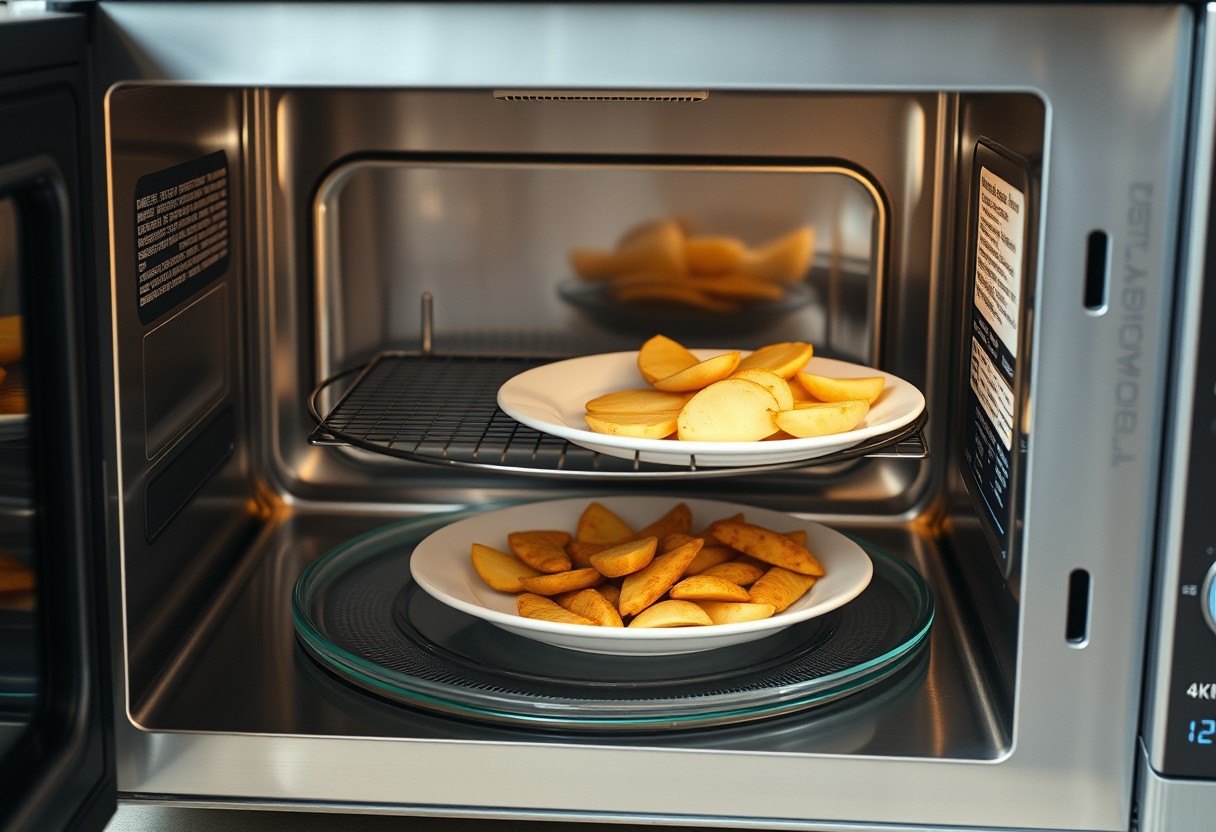
You can avoid cold spots and scorching by arranging food in strategic layers before microwaving. Uneven heating is not just frustrating-it can be unsafe, leaving bacteria-laden zones in meats and dense dishes. With the right layering method, you’ll achieve consistent temperatures throughout your meal, preserving texture and flavor. This technique transforms how leftovers and meal-prepped dishes reheat.
Key Takeaways:
- Arrange food in a circular, ring-like pattern with the densest parts on the outer edge to expose all sections to more consistent microwave energy and reduce cold spots.
- Use microwave-safe covers or damp paper towels between layers to trap steam, which helps heat food more evenly and prevents dryness.
- Pause halfway through heating to stir, flip, or rearrange inner and outer portions, allowing cooler sections to move into areas of stronger microwave activity.
Understanding Microwave Physics
Microwaves heat food through molecular friction, not ambient heat. When you press start, electromagnetic energy penetrates your meal, targeting water molecules directly. These molecules rapidly flip orientation in response to the changing field, generating internal heat through motion. This process means heating begins inside the food, not from the outside in. The most intense reactions occur where moisture is highest, which can create uneven temperatures if layers aren’t arranged strategically.
How electromagnetic waves interact with water molecules
Your microwave emits waves that excite polar molecules, especially water. As these molecules absorb energy, they spin and collide, producing heat through friction. Since microwaves penetrate only about one to one and a half inches into food, deeper areas rely on conduction to warm up. This direct interaction explains why moist regions heat faster than dry ones, often leading to hot spots if layering isn’t optimized for even exposure.
Why the center of dense food stays cold
Dense foods like thick stews or mashed potatoes resist uniform wave penetration. Microwaves lose energy as they enter, heating outer layers while the core receives minimal direct exposure. Conduction must carry heat inward, but it’s often too slow to fully warm the center during typical cook times. You’ll find the middle remains stubbornly cold despite bubbling edges, especially when ingredients are tightly packed without strategic layering.
Selecting the Best Containers for Layering
Choose broad, shallow vessels to expose more food surface to microwave energy, promoting consistent heating throughout. Wide containers allow waves to reach more areas simultaneously, reducing cold spots that deep dishes often trap. Glass and ceramic dishes with wide rims are ideal because they distribute heat evenly and resist warping. Avoid narrow or tall cookware, as their shape limits wave penetration and encourages overheating at the edges while centers stay cool. Your choice of dish directly impacts how well layered meals reheat.
Benefits of wide-rimmed glass and ceramic
Wide-rimmed glass and ceramic containers handle temperature shifts well and won’t absorb microwave energy, letting heat pass directly into your food. These materials promote steady, even warming without hotspots that plastic can sometimes cause. They’re also non-porous and resist staining or odor retention, making them safer for repeated use. When you layer meals in these dishes, the broad opening ensures that more of the food sits within optimal range of the microwave’s energy field, increasing efficiency and consistency.
Avoiding deep bowls to prevent edge-scorching
Deep bowls concentrate microwave energy at the outer edges, where waves enter the cavity, often leaving the center cold while the perimeter overcooks. This uneven exposure leads to scorched outer layers and underheated centers, especially in dense dishes like casseroles or rice-based meals. By using shallow containers instead, you reduce the depth that waves must penetrate and allow more uniform dispersion. Your food heats more predictably when it’s spread out, minimizing the risk of burnt edges and unpleasant textures.
The Ring-Style Layering Technique
Arranging your food in a circular, ring-style pattern significantly improves heating consistency by eliminating the cold spot that often forms in the center of microwaved dishes. When you leave the middle of the plate empty and position ingredients in an even outer circle, microwaves penetrate each section more uniformly, reducing the chance of undercooked centers that can harbor harmful bacteria. This method works especially well with mixed dishes, where dense and light components are spaced for balanced exposure. The open center allows energy to circulate back toward the interior, promoting more predictable results with every use.
Positioning proteins on the outer perimeter
Placing proteins like chicken, beef, or fish along the outer edge of the dish ensures they receive the most intense microwave energy, which is essential for safe and thorough cooking. These denser foods absorb more radiation and benefit from the higher field intensity near the plate’s edge. By situating them in the ring’s outer half, you prevent undercooking while allowing thinner or more delicate ingredients to occupy inner positions. This strategic layout takes advantage of natural wave distribution, so your proteins finish at the same time as the rest of the meal without overcooking the sides.
Creating a “donut” shape for uniform radiation
Forming a “donut” shape-where food is arranged in a continuous outer ring with a clear center-maximizes exposure to microwave energy and prevents heat-trapping dead zones. The open middle allows waves to reflect back into the food from multiple angles, reducing shadowing and hotspots. You’ll notice more consistent temperatures across the dish, especially with thicker items like potatoes or casseroles. Keep the ring width even, so no section is overly thick, and avoid piling food too high, which can block penetration and defeat the purpose of the pattern.
Factors Influencing Layer Thickness
Layer thickness directly affects how evenly your food heats in the microwave. Thin layers allow microwaves to penetrate all the way through without overcooking the outer portions, especially important for dense or slow-conducting ingredients. When you stack food too thickly, the exterior can become rubbery or scorched while the center remains cold. For consistent results, aim for layers no more than 1.5 inches deep. Denser foods require thinner profiles to avoid uneven temperature distribution, while looser mixtures tolerate slightly greater depth.
- Thin layers ensure even heat penetration
- Dense ingredients need reduced layer depth
- Maximum 1.5 inches is ideal for most dishes
- Overly thick layers lead to cold spots and texture damage
- Uniform depth supports consistent cooking
Optimal depth for high-density starches
Dense starches like potatoes, rice, or pasta retain heat slowly and absorb microwaves unevenly when piled too high. You should limit layers of these foods to about one inch to prevent the edges from drying out while the center lags in temperature. Microwaves struggle to reach the core of thick starch clusters, increasing the risk of scalded surfaces and underheated interiors. Keeping portions shallow ensures the energy disperses more uniformly, resulting in a fully warmed, pleasantly textured dish every time.
Managing moisture levels in multi-component meals
When combining ingredients with different water content, layer thickness influences steam distribution and texture preservation. Thick zones of moist components, such as tomatoes or fish, can flood adjacent drier layers if not balanced properly. You must keep wet elements in thinner strata to control vapor release and avoid soggy results. Excessive depth in high-moisture sections traps steam, which may cause splattering or gumminess. A measured approach maintains separation and promotes even thermal transfer without compromising structural integrity.
Essential Tips for Mid-Cycle Adjustments
Manual intervention during microwaving disrupts cold spots and redistributes heat, especially in dense or tightly layered foods. Without periodic adjustments, outer layers absorb most energy while inner portions remain underheated. Stirring or repositioning food halfway through ensures more uniform results. Always use oven-safe utensils and avoid metal to prevent arcing. The brief pause also allows heat to conduct naturally, reducing the risk of scalding when you finally serve.
- Pause the microwave at the halfway point to stir or flip food layers
- Use a microwave-safe spoon or fork to avoid damaging the dish or oven
- Rotate dishes 180 degrees if stirring isn’t possible
- Keep the lid or cover in place until stirring to retain residual heat
- Be cautious of steam bursts when lifting covers
The importance of the halfway-mark stir
Stirring at the halfway point actively redistributes heat from the outer edges to the cooler center, breaking up thermal barriers created by dense ingredients. This action is especially effective in dishes like casseroles or rice-based meals where the bottom layer heats faster. You’ll notice a dramatic improvement in consistency, with fewer cold pockets and reduced risk of overcooking the edges. Always stir gently to maintain texture while ensuring even exposure to microwave energy.
Rotating the dish to compensate for oven hotspots
Most microwaves emit energy unevenly, creating hotspots that typically concentrate in the center or one quadrant. Rotating the dish 180 degrees mid-cycle counteracts this imbalance, exposing different sections to stronger energy zones. You’ll achieve more consistent heating without relying solely on standing time. For best results, combine rotation with a slight inward push of outer layers using a heat-resistant utensil, especially in wide, shallow containers.
Advanced Moisture Retention Strategies
Steam plays a pivotal role in maintaining moisture across layered foods, especially when trapped under a proper cover. Without adequate steam retention, the top layers lose moisture rapidly and become tough or rubbery. A covered environment forces vapor to circulate, dramatically reducing surface drying while promoting internal temperature balance. For those exploring design innovations, Would a honeycombed shape lid allow for more evenly … remains an open question rooted in how micro-chambers might influence condensation patterns.
- Use microwave-safe lids with built-in vents to regulate steam release
- Cover dishes with damp paper towels when no vented lid is available
- Avoid sealing containers airtight-trapped pressure can cause splattering or warping
- Reposition the cover slightly mid-cycle to redistribute condensed moisture
- Choose dome-shaped covers to encourage even condensation return to food
| Strategy | Effect on Food |
|---|---|
| Damp paper towel cover | Prevents crust formation and adds immediate surface hydration |
| Vented plastic lid | Enables controlled steam escape, minimizing sogginess |
| Dome-shaped cover | Promotes condensation runoff back onto upper layers |
| Mid-cycle uncovering | Releases excess moisture to prevent texture degradation |
Using damp paper towels for hydration
A simple yet effective method involves placing a lightly damp paper towel over your layered dish before microwaving. This barrier introduces immediate moisture into the top layer, preventing it from hardening or shrinking during initial heating cycles. The fibers hold enough water to generate localized steam without soaking the food, making it ideal for reheating casseroles or stacked leftovers. You’ll notice improved texture consistency, particularly in items like lasagna or rice bowls, where dryness often ruins the eating experience.
The benefit of vented lids for steam distribution
Vented lids manage internal humidity by allowing excess steam to escape while retaining enough to keep food moist. Without vents, condensation pools and drips unevenly, potentially cooling hot spots and creating texture inconsistencies. With a properly vented cover, steam circulates and exits gradually, maintaining a stable thermal environment across all layers. This balance prevents both drying and sogginess, resulting in uniformly heated meals that preserve their original quality far better than uncontrolled setups.
Summing up
You now know how to microwave food in layers for more even heating by arranging ingredients strategically and using the ring-style method. Placing denser items toward the outer edge and thinner portions in the center prevents cold spots. Rotating and stirring at key intervals improves results, as does covering food to trap steam. Your choice of container and layer thickness directly affects outcomes. With these techniques, your meals heat consistently and retain quality.
FAQ
Q: Why does food heat unevenly in the microwave when stacked in layers?
A: Microwaves penetrate food from the outside in, typically reaching only 1 to 1.5 inches into the material. When food is piled in thick or dense layers, the outer portions absorb most of the energy while the center remains cold. Layering food in a ring shape with space in the middle allows microwaves to strike more surfaces directly, improving heat distribution and reducing cold spots.
Q: Can I use any container for layering food in the microwave?
A: Not all containers work well. Use microwave-safe glass or ceramic dishes that are shallow and wide, which support even layering. Avoid deep or narrow containers that encourage vertical stacking. Metal pans or containers with metallic trim must be avoided, as they reflect microwaves and can cause sparking or uneven cooking.
Q: How thick should each layer be when microwaving food?
A: Each layer should be no more than 1.5 inches thick to allow microwaves to penetrate fully. Thicker layers, especially in dense foods like potatoes or meat, will heat unevenly. For best results, spread ingredients like casseroles or stews in a uniform ring around the edge of the dish, leaving the center open for direct energy exposure.
Q: Do I need to stir or rotate food when using the ring layering method?
A: Yes, rotating the dish halfway through cooking helps balance hot spots created by the microwave’s uneven energy distribution. For dishes with multiple components, gently stir or shift inner portions to the outer edge mid-cycle. This ensures all parts receive similar exposure, especially important in meals with mixed textures or moisture levels.
Q: Is covering food necessary when microwaving in layers?
A: Covering food with a microwave-safe lid or damp paper towel traps steam, which aids in even heating and prevents drying. For layered dishes, this is especially helpful in softening dense ingredients and maintaining moisture in proteins or grains. Just make sure the cover is vented slightly to let excess steam escape and avoid sogginess.