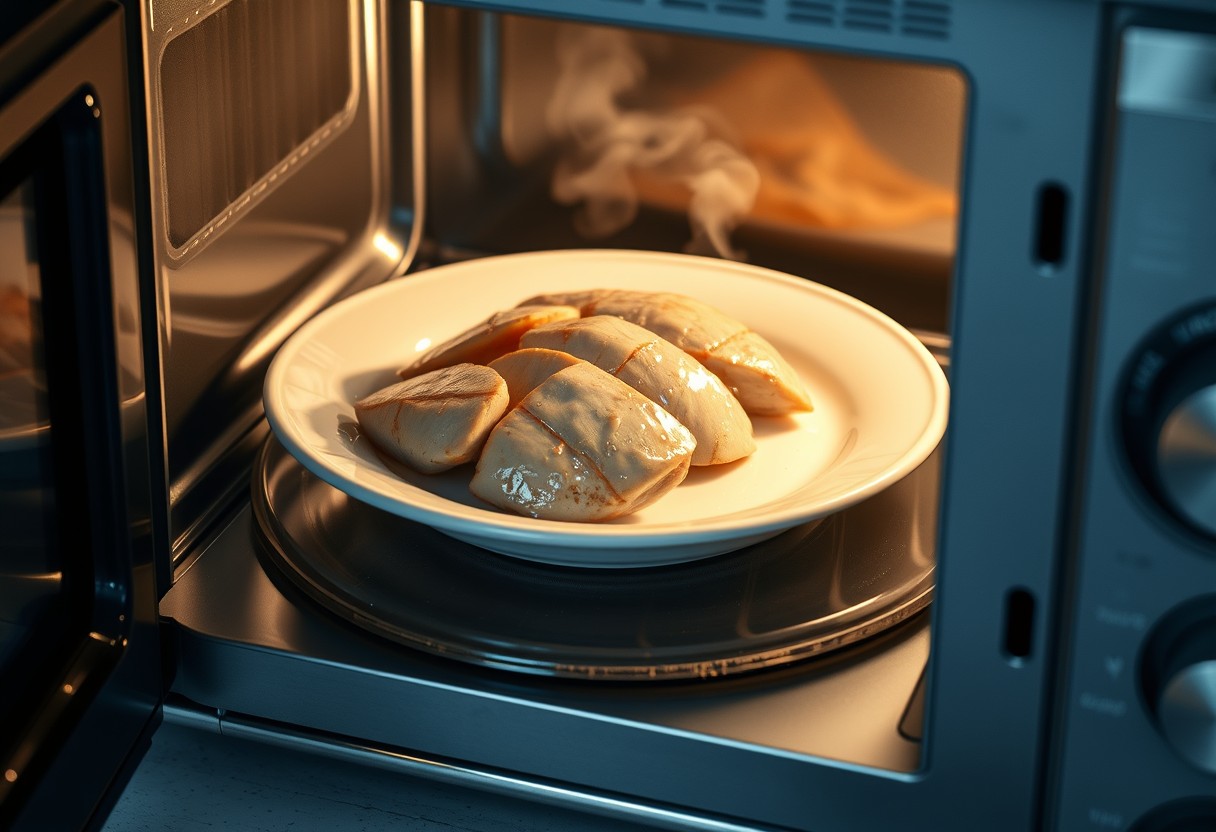
You’ve covered your leftovers, hit start, and still ended up with rubbery chicken or parched rice. Microwaves excite water molecules to generate heat, but that process often forces moisture out faster than it can be retained. Even with a lid, steam escapes or condenses unevenly, leaving parts of your meal dry. You’re not overheating-it’s how the appliance fundamentally cooks.
Key Takeaways:
- Microwaves heat food by agitating water molecules, but this energy can quickly turn liquid into steam, removing moisture from food even when covered.
- Covering food helps trap some steam, yet many microwave-safe lids don’t create a fully sealed environment, allowing humid air to escape and dry out meals over time.
- Uneven heating causes certain areas-especially edges-to overcook and lose moisture faster, leading to splotchy textures and a parched feel despite using a cover.
The Molecular Scramble
Every time you press start, your microwave unleashes electromagnetic waves that penetrate food at a molecular level. These waves target water molecules specifically, forcing them to spin rapidly in an attempt to align with the shifting electromagnetic field. This motion, known as dipole rotation, generates intense internal friction. As the molecules collide and transfer energy, heat builds from within. The speed and intensity of this process can overwhelm the food’s natural structure, breaking down cell walls and releasing moisture faster than it can be retained-even when covered.
Dipole rotation and molecular friction
Water molecules carry a positive and negative end, making them responsive to the microwave’s alternating electric field. When the field flips billions of times per second, each molecule rapidly rotates to keep alignment. This constant spinning creates friction between neighboring molecules, producing heat from within the food. The energy transfer happens so quickly that heat concentrates unevenly, often peaking in water-rich zones. You’re not just warming your meal-you’re agitating its most essential component at a microscopic level, accelerating moisture loss before you even notice it’s happening.
The rapid transition to vapor
As internal temperatures spike, trapped water molecules gain enough kinetic energy to shift from liquid to vapor in seconds. Unlike conventional heating, which allows gradual evaporation, microwaves generate steam internally, where pressure builds beneath the surface. This steam doesn’t gently escape-it bursts outward, carrying moisture with it. The transformation occurs so fast that food fibers can’t hold onto water, even under a cover. By the time you open the door, much of the original hydration has already been converted and lost, leaving behind a drier texture than intended.

The Great Steam Escape
Most microwave-safe lids give a false sense of security, promising moisture retention while allowing steam to seep out at every weak point. The reality is that even a snug-fitting cover rarely forms a true seal, letting pressurized vapor escape through microscopic gaps around the rim. This loss of steam means your food loses internal moisture faster than you realize, especially during longer heating cycles. What you assume is a protective barrier is often just a partial shield-one that does little to stop the steady migration of water molecules into the air above your meal.
Pressure differentials and escaping gas
Steam builds pressure the moment your food heats up, and without a fully sealed environment, that pressure forces moisture-laden air through any available opening. Your container becomes a one-way system: heat and water vapor rise, but instead of recirculating, they escape into the microwave cavity, never to return. Even slight warping in plastic lids or uneven container edges creates escape routes, making it nearly impossible to maintain internal humidity. The result is a continuous loss of moisture that accelerates the longer the microwave runs.
Condensation versus absorption
When steam condenses on the underside of a lid, it forms droplets that often fail to return to the food below. Instead of being reabsorbed, this moisture clings to the plastic or ceramic surface and evaporates during subsequent heating cycles. You might see water on the lid and assume your meal stayed moist, but that condensation is actually evidence of lost hydration. The longer the food cooks, the more of this condensed water disappears into the air, leaving your meal progressively drier despite the visible dampness above it.
The Edge of Desiccation
Energy inside your microwave doesn’t spread evenly-instead, it forms patterns that leave some zones absorbing far more heat than others. You’ve likely noticed how the outer rim of your leftovers often turns tough and parched while the center stays cool. This happens because certain spots receive intense bursts of radiation, rapidly boiling off moisture where food meets air. Even with a cover, these edge regions lose water faster than it can be redistributed, leading to an unpleasantly dry perimeter around otherwise edible portions.
Standing waves and localized dehydration
Waves bouncing inside the cavity create hotspots where peaks align, concentrating energy in fixed locations. If your food sits in one of these zones, especially along the edges, water molecules vaporize aggressively in those specific areas. You’re not imagining it when one corner turns leathery while another stays moist-standing waves literally cook different parts at drastically different rates. Covers trap steam overall but can’t prevent this uneven energy concentration from sucking moisture out of vulnerable outer sections.
Surface area to volume ratios
Fragments near the edge expose more surface relative to their mass, accelerating moisture loss during heating. Each exposed edge acts like an open window for steam to escape, and microwaves target these thin zones with disproportionate intensity. Because smaller or thinner portions dehydrate faster due to their geometry, even brief heating can render outer bites dry and unpalatable. Your cover slows ambient evaporation but won’t compensate for the physical reality that slender edges give up water more readily than dense centers.
The High-Wattage Blunder
Running your microwave at full power might seem efficient, but it triggers a structural moisture crisis in leftovers. High wattage delivers intense bursts of energy that rapidly excite water molecules, especially near the surface. This causes them to vaporize too quickly, before heat can evenly distribute inward. As steam escapes, the outer layers dry out while the center remains cold. You’re left with rubbery edges and uneven texture, even if you used a cover. The damage isn’t just surface-level-it disrupts the food’s internal moisture balance beyond easy recovery.
Magnetron pulses and rest periods
Modern microwaves use magnetron pulses to generate heat, but at high wattage, the on-cycles dominate with little to no off-time. This means your food absorbs energy almost continuously, giving water molecules no chance to redistribute or reabsorb. The result is aggressive evaporation that overwhelms the food’s ability to retain moisture. Lower settings introduce strategic pauses, but full power eliminates these rest periods entirely, accelerating dryness from the first second.
The limits of thermal conduction
Thermal conduction in food is inherently slow, especially in dense or fibrous leftovers like chicken or casseroles. At high wattage, the microwave heats the outer zones so rapidly that internal moisture can’t migrate outward evenly. Instead of gentle warming, you get a steep thermal gradient-scorching edges and a cold core. The heat doesn’t have time to balance, and surface moisture vanishes before the center even begins to thaw, sealing in dryness where it matters most.
The Damp Towel Gambit
Placing a slightly damp towel over your dish tricks the microwave into maintaining a humid microclimate, slowing moisture loss during heating. The water in the fabric evaporates gradually, replenishing steam that would otherwise escape, keeping proteins tender and starches soft. Always use a clean cotton towel-synthetics risk melting or off-gassing. Never seal the dish completely; leave one corner loose to prevent pressure buildup. For safety insights on unusual microwave practices, see Why is it not recommended to microwave a can even ….
The auxiliary water glass method
A small glass of water placed beside your meal absorbs excess energy and releases vapor, effectively buffering the cavity’s dryness. As microwaves hit the liquid, it heats and steams, introducing humidity that protects delicate textures like fish or rice. Use a tall, microwave-safe glass filled halfway to avoid boiling over. This simple addition balances the environment without altering your food’s structure or flavor.
The wet paper wrap strategy
Wrapping food loosely in a moistened paper towel creates an instant steam barrier that shields surfaces from direct radiation. The damp cellulose emits water vapor precisely where it’s needed, preventing crust formation and preserving juiciness. Limit exposure to two minutes to avoid disintegration of the paper. Choose unbleached towels to reduce chemical leaching risks under heat.
The Porcelain Heat Thief
Dinnerware isn’t just a container-it actively shapes how your food reheats. When you use thick ceramic plates or bowls, they absorb a significant amount of microwave energy, drawing heat away from your meal. These materials conduct heat slowly but steadily, creating what’s effectively a thermal sink. As a result, the outer edges of your food may scorch while the center stays cool, and the overall moisture balance suffers because less energy reaches the food itself. Your dish becomes a silent accomplice in drying out your meal.
Ceramic conductivity and heat sinks
Ceramic dishes pull heat from your food because they’re dense and retain thermal energy well. While this seems helpful, it means the plate heats up instead of your leftovers, especially during longer cycles. The material’s low thermal conductivity causes uneven energy distribution-surface layers of food dry while inner portions wait for warmth. A cold ceramic plate can sap up to half the initial heat meant for your meal, leaving you with a lukewarm center and overheated edges locked in a moisture-starved state.
Porous surface issues
Porous ceramics, like unglazed stoneware or older dinnerware with micro-cracks, trap steam and moisture from prior uses. During reheating, that trapped water heats unevenly, sometimes releasing bursts of steam that disrupt gentle warming. Worse, these surfaces absorb microwave energy inefficiently, leading to hot spots on the dish that further dehydrate adjacent food. You might not see the damage, but your chicken or rice pays the price: localized dryness and texture loss occur where the plate interacts most.
Conclusion
You now know that even with a cover, your microwave can dry out food because it heats unevenly and fails to retain consistent moisture. The cover helps trap some steam, but microwave energy excites water molecules rapidly, leading to localized dry spots. Edges overcook while centers stay cool, and materials like porcelain pull heat away. High power settings worsen the effect. Adjusting power levels, using damp towels, and stirring improve results, but physics limits what a cover alone can fix.
FAQ
Q: Why does my food still dry out in the microwave even when I cover it?
A: Covering food helps trap steam, but microwave heating is inherently uneven. The electromagnetic waves excite water molecules primarily near the surface and in high-moisture zones, causing localized boiling. This creates pockets of intense heat that evaporate moisture faster than the cover can contain it. The cover may slow steam loss, but it can’t prevent internal dehydration where energy absorption is strongest.
Q: Doesn’t a microwave cook from the inside out?
A: No, microwaves penetrate food to a depth of about one to two centimeters, depending on density. They heat the outer layers first, and the center warms through conduction. This misconception leads people to leave food in too long, overcooking the edges while waiting for the middle to heat. The prolonged exposure dries out the outer portions, even under a cover.
Q: Can the type of container affect how dry my food gets?
A: Yes. Materials like thin plastic or paper absorb little heat, so they don’t retain warmth after cooking. In contrast, thick ceramic or stoneware absorbs microwave energy and continues radiating heat after the cycle ends, effectively steaming food further. A plate that stays warm helps maintain moisture, while a cold container accelerates surface drying.
Q: Why does reheated pizza end up tough and leathery, even with a damp paper towel?
A: Pizza crust contains starch that undergoes retrogradation when cooled, then re-gelatinizes unevenly in the microwave. The damp towel adds surface moisture, but the intense, rapid heating dehydrates the proteins and starches before steam can redistribute. The result is a soggy bottom from trapped steam and a dry, rubbery top from localized overheating.
Q: Is lower wattage better for keeping food moist?
A: Lower power settings cycle the magnetron on and off, allowing time for heat to spread through conduction. A mid-sized SaaS firm might run servers nonstop, but a microwave needs pauses to let temperature equalize. Using 50-70% power for longer periods reduces hotspots and gives moisture time to migrate back into drier areas, significantly improving texture and moisture retention.