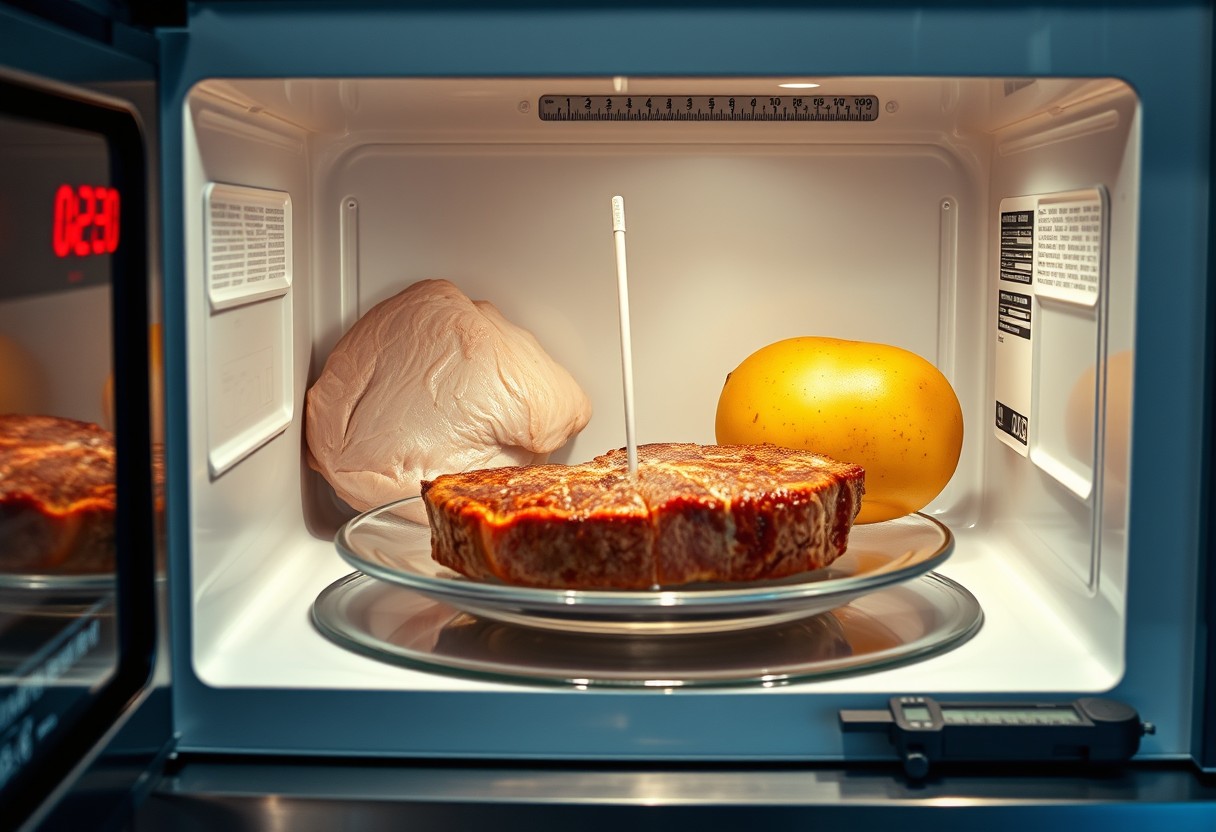
You’ve likely noticed some parts of your meal scorch while others stay cold, even when using the same setting. Food shape and thickness directly determine how evenly and quickly microwaves heat your meal. Irregular shapes create hot spots, while thick centers often remain undercooked due to limited wave penetration. Understanding these factors prevents foodborne risks and improves results, giving you safer, more consistent outcomes every time.
Key Takeaways:
- Thicker food items take longer to cook in the microwave because microwaves penetrate only about 1 to 1.5 inches into food, leaving the center to heat through conduction, which slows the overall process.
- Foods with irregular shapes-like a chicken leg or a chunky stew-heat unevenly since corners and thin edges absorb more energy and warm faster than dense or shielded areas.
- High surface-area-to-volume ratios, such as in sliced vegetables or flat patties, lead to quicker cooking times compared to whole or compact pieces due to more direct exposure to microwave energy.
The Geometry of the Heat
Your microwave’s energy doesn’t distribute evenly-it clusters in certain zones based on how your food is arranged. The shape of your container directly influences where hotspots form, with rounded edges potentially causing wave concentration that leads to uneven cooking. Corners and sharp edges in rectangular dishes can overheat, while smoother transitions in circularware promote more uniform exposure. You’re not just heating food-you’re guiding electromagnetic behavior through physical layout, and subtle design choices have immediate, measurable effects on doneness.
Circular vs Rectangular Vessels
Round containers tend to distribute microwaves more evenly because they eliminate corners where energy can accumulate. In contrast, rectangular dishes create focal points at their edges, often resulting in overcooked corners and cold centers. When you use a square or oblong dish, the waves reflect off flat walls and interfere unpredictably, increasing the risk of scalded spots. A circular vessel encourages smoother wave circulation, reducing dead zones and supporting consistent thermal development across the meal.
The Donut Hole Advantage
Placing food in a ring shape with a space in the center improves heat penetration by allowing microwaves to pass through the open zone and strike the inner surface. This gap prevents energy from being blocked by dense outer layers, enabling more balanced cooking throughout the mass. Without the central void, waves may struggle to reach the core, leaving it underheated. The empty center acts like a conduit, giving radiation access from all angles and minimizing cold spots that commonly plague solid mounds of food.
The Wall of Resistance
Microwaves lose energy rapidly as they enter food, typically penetrating only 1-2 centimeters before their intensity drops significantly. This means the outer layers absorb most of the energy, while deeper regions rely on conduction to warm through. If you’re heating a thick portion of food, the center may remain cold even after the outside feels hot, creating a dangerous temperature zone where bacteria can survive. The physical depth of your dish isn’t just a matter of convenience-it directly limits how thoroughly microwaves can reach.
Critical Thickness Thresholds
Most microwave energy is absorbed within the first 1.5 inches of food, making dishes thicker than this especially prone to uneven heating. When you place a dense casserole or large chunk of meat in the microwave, the outer layers shield the interior, leaving a significant volume undercooked. For items exceeding this threshold, you face a high risk of consuming unheated food, particularly in homogenous, dense preparations where heat doesn’t transfer easily. Reducing thickness through slicing or shaping ensures more reliable results and safer outcomes.
The Cold Core Conundrum
You’ve likely experienced biting into a seemingly hot meal only to find a cold, even icy, center-this happens because microwaves can’t fully penetrate dense masses before their energy depletes. The core stays cold not due to timing alone, but because electromagnetic waves are physically blocked by the outer layers. This creates a persistent safety hazard, especially with foods like stuffed meats or thick stews that trap pathogens in unheated zones. Stirring or rotating helps, but geometry ultimately determines whether the center ever receives enough energy to rise to safe temperatures.
Molecular Vibration Ratios
Your microwave excites molecules through electromagnetic waves, but not all ingredients react with the same intensity. Water molecules respond quickly due to their polarity, rapidly aligning and rotating under microwave energy. Foods high in moisture heat faster because these molecular movements generate internal friction and, consequently, heat. In contrast, dense or dry foods-like raw potatoes or thick meat cuts-contain less free water, so their molecules vibrate more slowly and absorb energy less efficiently. This difference creates uneven cooking unless you adjust time or power.
Water and Fat Attraction
Water isn’t the only molecule that responds to microwaves-fat does too, though at a different rate. While water molecules rotate strongly under microwave exposure, fat molecules heat up more slowly but retain warmth longer once energized. This means fatty portions can become dangerously hot, even if the rest of the dish feels lukewarm. You’ll notice this when reheating foods like cheese or oily sauces, where pockets melt or sputter while surrounding areas remain cool.
Salt Concentration Hotspots
Salt alters how microwaves interact with food by increasing electrical conductivity in localized zones. Areas with higher salt content absorb energy more aggressively, leading to rapid temperature spikes. These hotspots can scorch or overcook before the rest of the dish reaches serving temperature, especially in marinated meats or seasoned casseroles. You’re likely to experience this when biting into a seemingly warm meal that suddenly burns your tongue in one spot.
Surface Area Dynamics
Exposing more surface area directly accelerates how quickly your food absorbs microwave energy. Microwaves penetrate only a short distance into food, so spreading it out increases the portion in direct contact with radiant waves. When you arrange items in a ring or spread them thinly, you’re not just avoiding cold spots-you’re enabling faster, more complete heating. The outer layers heat first, and maximizing that exterior face means more molecules start vibrating immediately, reducing overall cook time significantly.
Flattening for Uniformity
Shaping food into even, flat layers ensures microwaves interact with consistent depth across the entire portion. When you press ground meat into a patty or spread leftovers into a shallow dish, you eliminate thick pockets that lag in temperature. This uniformity allows energy to distribute evenly, so no single zone absorbs excessive radiation while others remain cold. You achieve balanced results because each section responds to heat at nearly the same rate, minimizing the need for constant stirring or repositioning during cooking.
The Danger of Tapered Edges
Tapered or uneven edges heat far faster than thicker centers, creating a serious risk of burning before the main body is warm. These thin regions expose more surface per volume, making them absorb microwave energy disproportionately. You might notice crispy corners on a casserole or rubbery tips on reheated chicken strips-signs that overheating occurred where thickness dropped below optimal levels. Avoid this by trimming components to match thickness or shielding delicate ends with small covers of microwave-safe material.
Kinetic Momentum
Heat continues moving through your food even after the microwave stops, driven by residual molecular motion. You may think cooking ends when the timer dings, but thermal energy keeps migrating inward, especially in thick portions like the center of a casserole or a dense piece of meat. This delayed transfer means surface readings can be misleading-your meal might feel hot on the outside but remain undercooked within. Recognizing this momentum helps you avoid premature cutting or serving.
Conductive Heat Flow
After microwaving, internal temperature rises not from continued radiation but from conductive heat flow. Thermal energy stored in outer layers gradually spreads toward cooler regions, balancing the internal temperature. You experience this when a dish feels hotter two minutes after stopping the microwave. This post-cooking conduction is strongest in moist, dense foods like potatoes or lasagna, where molecules are tightly packed and transfer energy efficiently over time.
The Necessity of Standing Time
Standing time allows heat to finish its journey to the core, ensuring even doneness and safer consumption. Without it, you risk biting into a scalding exterior and cold center. Letting food rest for a few minutes can raise the internal temperature by several degrees, completing the cooking process naturally. This pause is not optional for thick or dense items-it’s a necessary step to achieve both safety and texture. Your patience directly impacts the final result.
Mechanical Interventions
Modern microwaves use magnetron cycling to manage uneven shapes and inconsistent food thickness. You’ll notice the power isn’t continuous but pulses on and off, allowing heat to diffuse more evenly through irregular portions. This cycling prevents outer edges from overcooking while giving inner zones time to absorb energy. Without this modulation, dense or oddly shaped foods would burn on the outside and stay cold within. The system adapts to geometry challenges automatically, making it easier to achieve uniform results even with complex dishes.
Variable Power Settings
Different foods respond better at specific power levels, and adjusting this setting gives you precise control over energy delivery. For thick cuts of meat or dense casseroles, lower settings with longer cycles reduce the risk of overheating the surface before the center warms. Running your microwave at 50-70% power can double effective cooking time but dramatically improve internal consistency. You’re not just reducing heat-you’re enabling deeper penetration without
Summing up
You now understand how the shape and thickness of food directly influence microwave cooking time. Dense, thick portions absorb energy more slowly than thin or evenly shaped items, leading to uneven heating. Irregular shapes create hot spots while leaving other areas undercooked. Your awareness of how microwaves penetrate food-typically 1 to 1.5 inches-helps explain why rotation and rest periods matter. Adjusting portion size and form gives you greater control over results, ensuring meals heat efficiently and safely every time.
FAQ
Q: Why does thicker food take longer to cook in the microwave?
A: Microwaves penetrate food from the outside in, typically reaching only 1 to 1.5 inches into the material. Thicker items, like a large potato or a dense casserole, have more mass beyond this penetration depth, so heat must travel inward through conduction. This secondary process is much slower than direct microwave absorption, leading to longer overall cooking times. A 3-inch meatloaf, for example, will need extra time after microwaving to allow internal heat to equalize, or it risks being cold in the center.
Q: Does the shape of food affect how evenly it cooks in the microwave?
A: Yes, shape directly influences microwave exposure and heat distribution. Round or oval foods, such as a whole potato, tend to cook more evenly because microwaves can access curved surfaces from multiple angles. In contrast, square or rectangular items, like a block of lasagna, develop hot spots at the corners where energy concentrates. These corners can overcook while the center remains cool. Arranging food in a ring shape, such as placing potatoes in a circle, improves uniformity by mimicking the turntable’s motion and reducing shadowing.
Q: Why do some parts of my food feel scalding while others are still cold?
A: Microwaves create standing wave patterns inside the cavity, resulting in areas of high and low energy. Food regions that align with high-energy zones absorb more radiation and heat faster. Thick sections or dense components, like a chunk of chicken in a stew, absorb energy slower than surrounding liquid, which heats rapidly due to high water content. The uneven combination of wave distribution, food geometry, and composition leads to temperature disparities. Stirring or rotating food during cooking helps balance these differences.
Q: How does surface area impact microwave cooking speed?
A: Foods with greater surface area, such as sliced vegetables or shredded cheese, expose more molecules to microwave energy, accelerating heating. A whole carrot takes longer to cook than the same carrot cut into coins because the slices allow deeper and more uniform wave penetration. Thin, flat items like bacon on a plate heat quickly across their broad face, while bundled or stacked foods shield inner layers, reducing efficiency. Spreading food out in a single layer optimizes contact with microwaves.
Q: Can the thickness of food lead to unsafe cooking results?
A: Yes, undercooked centers in thick foods pose a food safety risk. A chicken breast that is 2 inches thick may appear steaming hot on the surface but remain below safe internal temperatures where bacteria like Salmonella survive. Microwaves may not deliver consistent energy to the core, especially if the food is not rotated or allowed to rest. Using a food thermometer in the thickest part after cooking-and factoring in standing time-ensures the entire portion reaches a safe temperature.