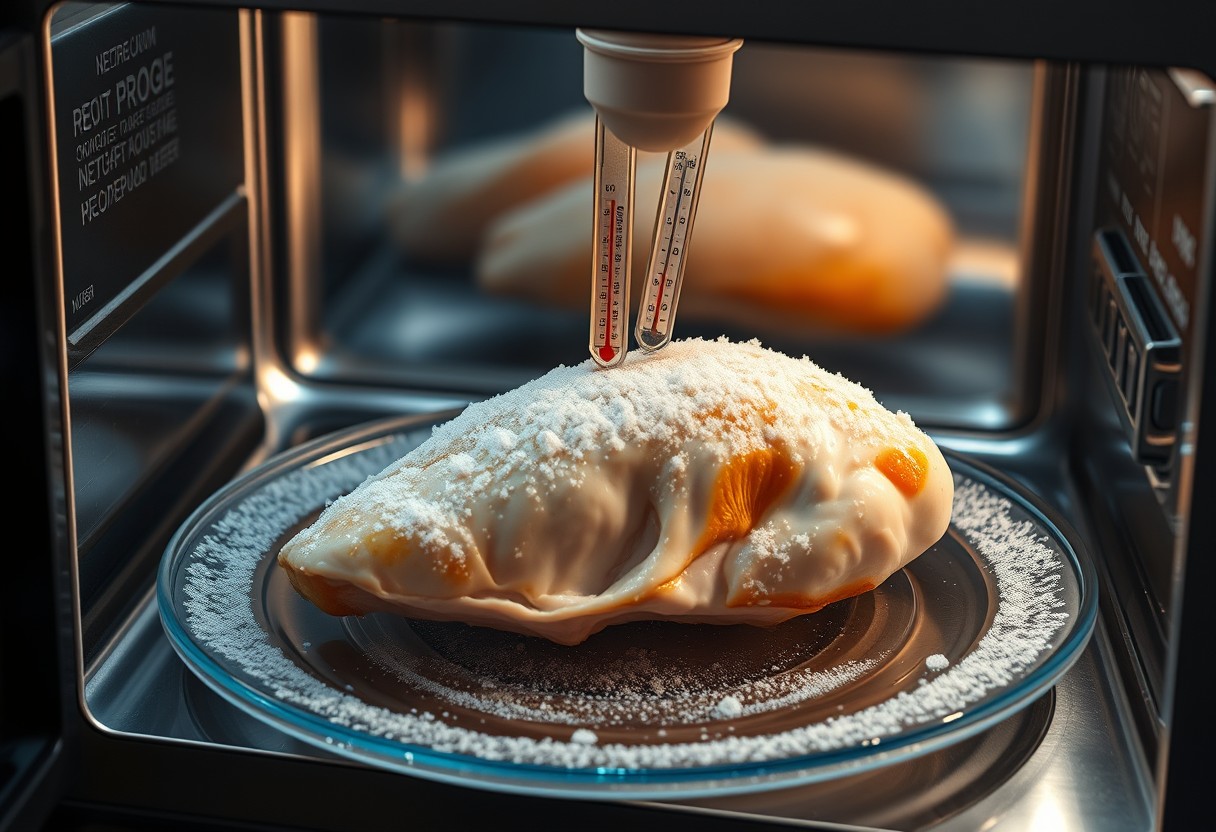
You’ve likely seen it happen: one edge of your chicken breast sizzles while the center remains frozen solid. This uneven thawing occurs because microwaves target water molecules, and frozen water absorbs energy differently than liquid water. As some areas thaw first, they heat rapidly, risking dangerous bacterial growth if left unchecked. Understanding this process helps you defrost food more safely and effectively.
Key Takeaways:
- Microwave defrosting heats food unevenly because microwaves target water molecules, and frozen water responds differently than liquid water, causing outer areas with more free water to absorb energy faster and begin cooking while inner sections remain frozen.
- The shape and density of food create natural hot spots-thin or protruding parts like edges or bone ends heat up quickly, while thick or compact areas thaw more slowly due to uneven microwave penetration and heat distribution.
- Many microwaves use a low-power defrost setting that cycles the magnetron on and off, but this doesn’t fully prevent cooking in sensitive zones, especially if the food lacks uniform composition or if the defrost process isn’t interrupted for manual repositioning.
The Frenetic Dance of Water
Dipolar Rotation
When you activate your microwave, electromagnetic waves penetrate your food and interact directly with water molecules. These molecules are polar, meaning they have a positive end and a negative end, causing them to rapidly spin in alignment with the oscillating electric field. This motion-called dipolar rotation-generates heat through molecular friction. You experience this as warming or even cooking, but only where liquid water exists. Ice, however, resists this rotation due to its rigid crystalline structure, leaving frozen zones largely unaffected while adjacent areas begin to cook.
Electromagnetic Friction
As microwaves pass through your food, their energy is absorbed unevenly based on molecular state. Liquid water molecules absorb most of this radiation, turning electromagnetic energy into thermal motion almost instantly. This creates pockets of intense heat that can reach boiling temperatures while nearby ice remains solid. The disparity arises because electromagnetic friction acts only on mobile dipoles-those not locked in ice’s lattice. You’re not just thawing; you’re inadvertently cooking the regions already free of crystalline bonds.
The Great Frozen Resistance
Even as microwaves pulse through your frozen meal, a silent standoff unfolds within. Ice’s crystalline structure resists energy absorption in a way liquid water never does, creating zones where frozen molecules remain locked while neighboring areas begin to heat. This uneven response isn’t random-it stems from how deeply microwaves penetrate and where they’re most readily absorbed. You’re not just fighting time; you’re contending with the physics of phase-bound materials that refuse to thaw on command.
Molecular Gridlock
Ice traps water molecules in a rigid lattice, preventing them from rotating freely when exposed to microwave energy. While liquid regions absorb radiation and warm rapidly, these frozen zones barely respond, creating pockets of resistance. You experience this as strange inconsistencies-some parts softening while others stay stubbornly icy. The gridlock breaks only when enough surrounding heat conducts inward, disrupting the crystal formation and allowing absorption to finally begin.
The Phase Change Barrier
Turning ice into water demands far more energy than simply raising temperature, a hidden hurdle known as latent heat. As microwaves strike your food, much of their power gets consumed in breaking molecular bonds rather than generating warmth. Until this transition completes in each region, no temperature rise occurs-meaning you can have adjacent areas at wildly different stages of thawing despite equal exposure. This invisible energy tax governs why some spots seem immune to defrosting until suddenly, they’re overcooked.
A Landscape of Hot and Cold
Inside your microwave, energy doesn’t spread evenly-it forms a pattern shaped by wave interference. As microwaves bounce off the metal walls, they create standing waves with peaks of high intensity and points of near-zero energy. Your food sits within this invisible grid, so some areas absorb intense radiation while others receive almost none. This mismatch explains why certain spots begin cooking while adjacent sections remain frozen. The physical shape and density of the food interact unpredictably with these wave patterns, leading to uneven thawing you can’t see but will taste.
Wave Interference
Waves reflecting inside the cavity collide and interfere, forming stable patterns where peaks and troughs align. At the peaks, energy concentrates, rapidly heating any food in those positions. Where waves cancel out, little to no heating occurs. These stationary patterns mean your microwave has fixed zones of strong and weak activity, regardless of what you’re defrosting. You can’t change this behavior-only work around it. This inherent interference is why no defrost cycle can fully prevent partial cooking.
Hotspots and Dead Zones
You’ve likely noticed some parts of your food scalding while others stay icy-a direct result of hotspots and dead zones. These are the visible effects of standing wave nodes: areas of maximum energy transfer and those starved of it. Rotating your dish helps but doesn’t eliminate the issue, especially with irregularly shaped items. Dense or thick regions often sit in dead zones, receiving minimal waves, while thinner edges overheat in hotspots. For more insights, see this discussion on the Microwave oven defrost setting. Is there any out …
The Geometry of the Meat Loaf
Shape directly influences how evenly your meat loaf thaws in the microwave. Sharp edges and thin regions expose more surface area to microwave energy, causing them to heat faster than thicker, more insulated sections. You’ve likely noticed these outer zones beginning to sizzle while the core remains frozen solid. This imbalance isn’t a flaw in your appliance-it’s physics responding to form. Areas with less mass absorb energy more rapidly, making uniform defrosting difficult without strategic intervention.
Corner Overheating
Corners act like microwave magnets, concentrating electromagnetic waves due to their exposed angles. These points have greater exposure and less thermal mass, so they begin cooking long before the center softens. You might see steam rising from a single edge while the middle stays icy-this is a common sign of uneven energy absorption. Once corners start to cook, protein begins to denature, increasing the risk of bacterial growth in partially heated zones, even if the bulk feels cold.
Penetration Depth Limits
Microwaves can only penetrate food to a certain depth-typically around 1 to 1.5 inches, depending on density and moisture. Beyond this, thawing relies on slow heat conduction rather than direct energy absorption. Your meat loaf’s thick center stays frozen because microwaves never reach it effectively during short cycles. This means outer layers endure repeated exposure while the core lags, creating a dangerous temperature gradient where pathogens could survive. Rotating or pausing helps, but won’t override this physical boundary.
The Deception of the Defrost Button
You likely trust your microwave’s defrost setting to thaw food evenly, but it operates on a cycle that alternates between emitting microwaves and pausing. During active bursts, the magnetron delivers full power, targeting water molecules in vulnerable areas, while inactive periods allow heat to redistribute slightly. This intermittent pattern prevents continuous cooking, yet some regions absorb energy too quickly, especially near edges or thin sections, leading to partial cooking while dense or frozen zones remain untouched. The label “defrost” masks this reality: it’s not gentle thawing, but controlled pulsing designed to minimize damage, not eliminate it.
Pulse-Width Modulation
Pulse-width modulation governs how long the magnetron fires during defrost cycles, switching between full power and idle states in timed intervals. Instead of reducing energy output, your microwave turns on at maximum intensity for a few seconds, then turns off for a longer duration. This cycling fools users into believing the appliance operates at lower power, but each active burst delivers the same intense radiation that excites water molecules aggressively. The result? Thin or exposed areas heat rapidly during on-phases, sometimes crossing into cooking temperatures, while internal zones stay frozen due to insufficient thermal diffusion between pulses.
Thermal Equilibrium
Thermal equilibrium is the natural process where heat moves from warmer to colder regions until uniformity is reached, but in microwave defrosting, time is severely limited. Even during off cycles, heat doesn’t have enough time to migrate from already-warmed outer layers into the still-frozen core. This imbalance means outer edges may begin to cook-altering texture and safety-while the center remains a breeding ground for pathogens. Your microwave can’t accelerate molecular heat transfer; it only pauses, hoping conduction catches up. In most cases, it doesn’t, leaving you with a deceptively warm yet dangerously under-thawed product.
Conclusion
You now understand why microwave defrosting creates uneven results. Microwaves target water molecules, so areas with higher moisture absorb more energy and begin cooking while still-frozen sections resist heating. The shape and density of your food, along with inconsistent microwave fields, contribute to cold spots and premature cooking. Relying solely on the defrost button can mislead, as it follows time-based assumptions, not real-time food behavior. For better outcomes, you rotate, separate, and check food manually, ensuring safer, more even thawing every time.
FAQ
Q: Why do some parts of my food begin to cook during microwave defrosting while others remain frozen?
A: Microwave energy targets water molecules, causing them to vibrate and generate heat. Areas with higher moisture content absorb more energy and warm up faster, sometimes reaching temperatures that initiate cooking. Meanwhile, denser or drier sections, like the core of a thick chicken breast, stay below thawing temperature because microwaves penetrate only so far and unevenly. This creates a patchwork of cooked edges and icy centers.
Q: Does the shape of the food affect how evenly it thaws in the microwave?
A: Yes, geometry plays a major role. Irregular shapes-such as a leg of lamb with varying thicknesses-cause microwaves to concentrate on protruding or thinner areas. These spots heat rapidly, while recessed or thicker zones receive less direct exposure. A uniformly shaped item, like a flat steak, tends to defrost more evenly than something with curves and corners that attract energy.
Q: Can the type of container or wrapping influence defrosting performance?
A: Absolutely. Metal pans or foil wrappers reflect microwaves and create hotspots or shield parts of the food, leading to erratic thawing. Even plastic containers labeled “microwave-safe” can trap steam unevenly. Using a microwave-safe plate without cover allows better air circulation, though loosely covering with a damp paper towel helps retain surface moisture and promotes more balanced heating.
Q: Is the defrost setting on my microwave actually designed to thaw food safely?
A: The defrost function cycles power on and off to allow heat time to distribute through conduction. However, it still relies on the same principles of microwave absorption and doesn’t fully prevent localized cooking. In practice, many users find the setting inconsistent, especially for large or dense items. Manual intervention-like flipping or separating pieces midway-often improves results more than relying solely on the preset button.
Q: What can I do to make microwave defrosting more even?
A: Break apart ground meat or poultry pieces as soon as they loosen during defrosting to expose frozen sections. Rotate the dish every few minutes and reposition thicker portions toward the outer edge of the turntable where energy is stronger. Pausing the microwave halfway lets heat migrate inward by natural conduction, reducing the chance of edge cooking. For best results, finish cooking immediately after thawing to avoid bacterial growth in partially warmed zones.