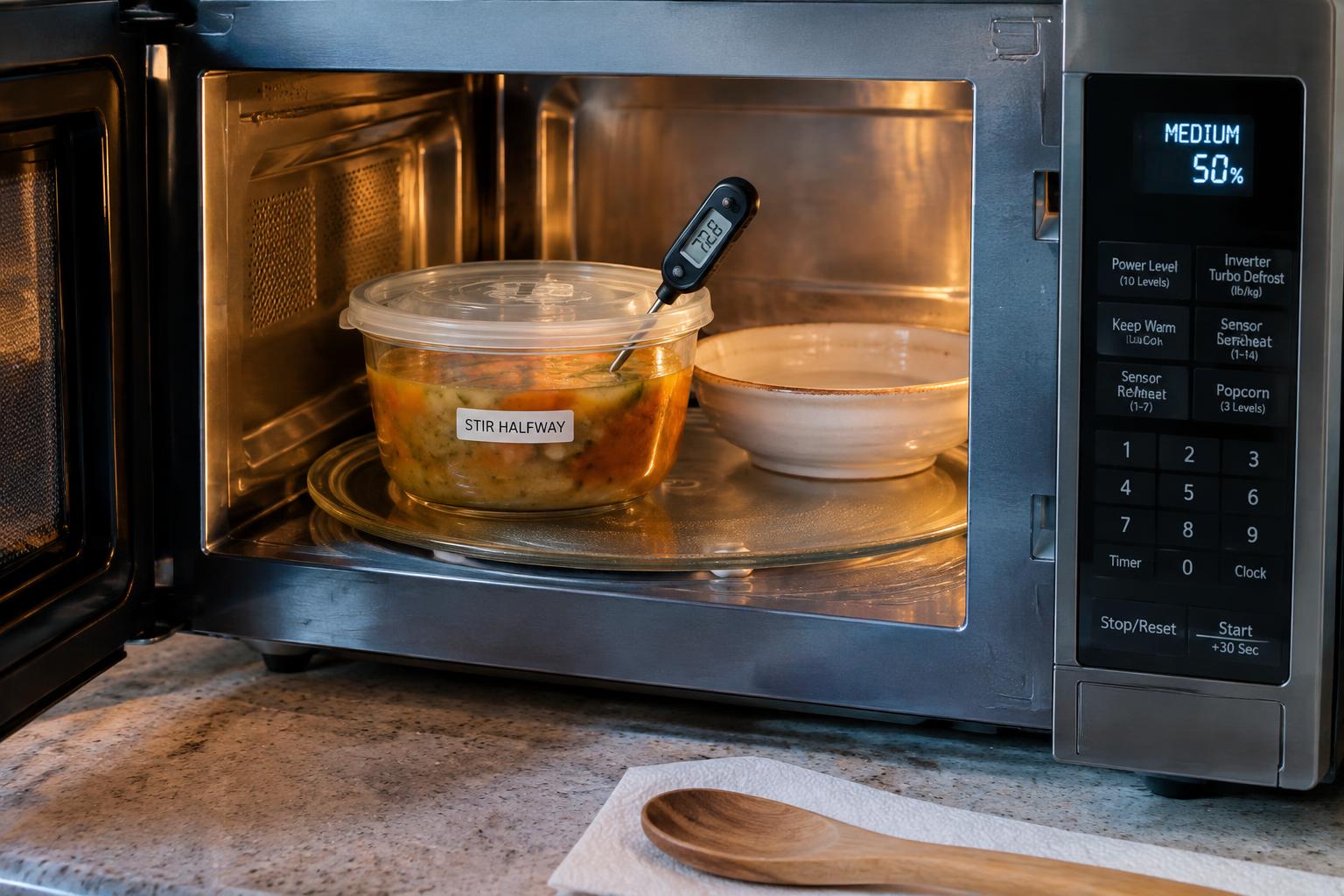
You’ve likely encountered cold spots in the center of your meal while the edges scorch-this dangerous temperature imbalance can harbor bacteria. Reheating food in deep containers poses unique challenges due to limited heat penetration. But with the right techniques, you can achieve even, safe, and consistently hot results every time, preserving both flavor and food safety.
Key Takeaways:
- Stirring or rotating food midway through reheating helps distribute heat evenly, especially in deep bowls where the center stays cold while edges overheat.
- Using lower power settings for longer durations allows heat to penetrate gradually, reducing hot spots and preventing outer layers from drying out before the inside warms.
- Covering containers with a damp paper towel or vented lid traps steam, promoting consistent temperature throughout the dish without making it soggy.
Understanding Heat Distribution Factors
Food density and container shape directly influence how evenly heat reaches your meal. Denser ingredients like potatoes or meats absorb thermal energy more slowly than lighter components, creating uneven temperatures within the same dish. The geometry of your container also plays a decisive role-wide, shallow dishes expose more surface area to consistent heating, while narrow or irregular shapes trap cold zones. A deep, cylindrical vessel can shield the center from direct thermal penetration, leading to potentially unsafe underheated portions. Round containers generally outperform square ones by minimizing corner overheating.
- Food density affects how quickly heat moves through different parts of the dish
- Container shape determines exposure to heat sources and risk of cold spots
- Round vessels promote more uniform thermal distribution than angular ones
- Deep containers hinder even heat penetration to the center
The role of moisture and fat content in heat absorption
Moisture conducts heat more efficiently than dry matter, meaning wetter areas of your food will warm faster and may even overheat while drier sections remain cool. Foods high in fat content absorb microwave energy differently due to their molecular structure, often heating more aggressively than lean components. This disparity can result in splattering or localized boiling next to still-cold zones. You must account for these variations when reheating mixed dishes, as sauces or gravies may reach scalding temperatures while embedded solids stay underheated, increasing the risk of uneven food safety outcomes.
How deep vessel height creates central cold spots
Height in deep containers limits how far heat can effectively travel into the core of the food. Thermal energy enters primarily from the outer edges, leaving the center reliant on slow conduction through surrounding material. In tall, narrow bowls, this results in a persistent cold spot at the middle, even after prolonged reheating. The deeper the dish, the greater the distance heat must migrate inward, increasing the likelihood that the center remains below safe serving temperatures. Stirring or redistributing contents becomes essential to counteract this inherent limitation of vertical geometry.
Selecting the Best Reheating Tools
Glass and ceramic containers outperform plastic when reheating food in deep vessels because they distribute heat more uniformly. These materials absorb microwave energy efficiently, reducing the risk of scorching at the edges while leaving centers cold. You avoid chemical leaching risks entirely with glass or ceramic, especially when heated, which can occur with lower-quality plastics. Their density supports steady thermal transfer, leading to consistently warm results. Always confirm the label states “microwave-safe” to prevent cracking from thermal stress.
Benefits of microwave-safe glass over plastic
Switching to microwave-safe glass eliminates exposure to harmful chemicals that may migrate into food during reheating. Plastic containers, even those labeled microwave-safe, can degrade over time and release compounds with repeated heat exposure. Glass maintains structural integrity and offers a nonporous surface that resists odors and stains. It heats evenly, supporting consistent temperature rise throughout deep dishes. This material choice enhances both safety and meal quality without sacrificing convenience.
Using vented lids to retain steam and moisture
Vented lids create a controlled environment that traps enough steam to keep food moist while preventing pressure buildup. Without proper ventilation, condensation accumulates and drips back unevenly, causing sogginess in spots and dryness elsewhere. A lid with a small steam opening balances humidity levels inside the container, promoting uniform warmth without compromising texture. This simple feature significantly improves outcomes, especially in dense or layered dishes where internal moisture is key to even reheating.
Preparing Food for Even Heating
Arrange your leftovers thoughtfully to ensure heat reaches all parts evenly. Break apart clumped items like pasta or rice and spread them into a uniform layer, keeping dense chunks away from the center. Leaving the middle empty creates a “donut” shape that prevents overheating at the edges and undercooking in the center, especially in microwave-safe containers. Stirring or flipping halfway through heating will further even out temperature, but initial placement makes a critical difference in final consistency and safety.
Creating a “donut” shape for microwave-bound dishes
Shape your food into a ring by removing a portion from the center, leaving space around the inner edge. This configuration allows microwaves to penetrate from all sides, reducing cold spots and avoiding a scalding rim with a cold core. Ideal for moist dishes like stews or casseroles, the donut method promotes balanced warming without overcooking the outer layers, ensuring every bite reaches a safe, palatable temperature in a single cycle.
Stratifying ingredients by density and thickness
Layer heavier, denser components like potatoes or meat at the outer edge of the container, where they’ll absorb more energy, while placing lighter, thinner items such as greens or fish in the center. This arrangement counteracts the microwave’s tendency to overheat edges while leaving centers cold and helps delicate foods avoid rubbery textures or dryness. Proper layering ensures ingredients with different thermal needs heat uniformly, preserving flavor and texture across the entire dish.
Mastering Microwave Power Settings
The advantage of 50 percent power for deep containers
You’ll achieve far better results when reheating thick or dense portions by setting your microwave to 50 percent power. At this lower intensity, heat penetrates gradually, giving the center time to warm without scalding the outer layers. High power settings cause immediate evaporation at the edges, leading to rubbery textures and cold spots in the middle. Using half power extends the reheating time slightly, but the trade-off is even, reliable warmth throughout-especially critical in deep bowls or casserole dishes where microwave energy struggles to reach the base evenly.
Timing the stir-and-rotate cycle for consistent results
Pausing halfway through allows you to stir and rotate the contents, redistributing heat from the outer edges toward the cooler center. Without this intervention, even reduced power can leave pockets of cold food buried beneath overheated layers. For most deep containers, a single pause at the midpoint is enough-but if your dish exceeds three inches in depth, consider an additional brief stir after the first minute. This simple rhythm ensures consistent temperature and texture, transforming what could be a messy, uneven result into a uniformly heated meal.
Utilizing Oven and Stovetop Methods
Convection and conduction offer reliable control when reheating thick dishes like stews or casseroles. An oven surrounds the container with steady, ambient heat, reducing the risk of scorching while promoting even warmth through dense layers. On the stovetop, direct conduction allows gradual temperature rise, especially when combined with a lid and moisture. Both methods outperform rapid heating techniques by minimizing hot spots and preserving texture. Always use oven-safe containers and monitor internal temperature near the center.
Low-temperature oven reheating for dense layers
Set your oven to a low temperature between 275°F and 300°F to gently reheat heavy dishes without drying the edges or leaving the center cold. Place the covered casserole or stew in the center rack, allowing warm air to circulate evenly. This slow approach ensures the heat penetrates deep into the thickest part of the food without overcooking the outer layers. Glass or ceramic containers work best, as they distribute heat more uniformly than metal.
| Factor | Recommendation |
|---|---|
| Oven Temperature | 275°F-300°F for even penetration |
| Container Type | Use oven-safe glass or ceramic |
| Covering | Aluminum foil or lid to retain moisture |
| Heating Time | 30-45 minutes, depending on depth |
| Placement | Center rack for balanced airflow |
Stovetop simmering with added liquids and covers
Begin reheating on low to medium heat to avoid burning the bottom layer of your stew or casserole. Add a small amount of broth, water, or sauce to reintroduce moisture lost during storage-this also helps transfer heat evenly through the dish. A tight-fitting lid traps steam, creating a gentle, self-stirring effect that warms the upper layers while the base heats slowly. Stir occasionally to equalize temperature, but avoid frequent lifting of the lid to maintain consistent conditions. The simmering stage should never involve boiling, as this can degrade texture and create uneven hot zones.
Essential Tips for Post-Heating Quality
Allowing your food to rest after reheating is one of the most effective ways to improve final texture and temperature uniformity. During this pause, carryover cooking continues to distribute heat from the outer layers into the center, especially in dense dishes like casseroles or thick soups. Skipping this step can result in a dish that feels hot on the edges but remains unpleasantly cool in the middle. Letting food sit, covered loosely, gives time for thermal equilibrium to occur naturally and safely.
The importance of the carryover cooking period
Resting your food for several minutes after reheating allows heat to migrate inward, completing the cooking process without overexposing the exterior to energy sources. This period is especially critical for deep containers, where outer portions absorb more energy and reach high temperatures faster than the core. By letting the dish sit, you harness residual heat to gently bring the center up to serving temperature, reducing the risk of scalding the surface while leaving the middle underheated. Always cover the container lightly to retain warmth without trapping excess steam.
Verifying temperature consistency with a probe thermometer
A quick check with a probe thermometer eliminates guesswork and ensures your food is evenly reheated throughout. Insert the probe into the thickest, center part of the dish, avoiding contact with the container’s base or sides, which can give false readings. You want to confirm the coolest zone has reached at least 165°F (74°C), the safe threshold for most leftovers. If the temperature varies significantly between center and edges, let the food rest longer to allow internal heat redistribution before serving.
| Factor | Impact on Post-Heating Quality |
|---|---|
| Resting time | Enables carryover cooking and evens out temperature gradients in deep dishes |
| Covering method | Loose covering retains heat without creating sogginess from trapped steam |
| Container material | Dense materials like ceramic hold heat longer, extending carryover effects |
| Food density | Thicker foods require longer rest periods for internal heat penetration |
| Thermometer use | Provides accurate verification of safe, consistent internal temperatures |
Final Words
You now have the practical knowledge to prevent uneven heating when reheating food in deep containers. By adjusting your approach-using lower power settings, stirring when possible, and choosing the right equipment-you maintain both flavor and texture. Positioning food evenly, covering it properly, and allowing standing time after reheating further enhance results. These steps work together to ensure heat penetrates consistently from edge to center. You don’t need special tools or complicated techniques-just attention to detail and a few proven methods that deliver reliable outcomes every time.
FAQ
Q: Why does food in deep containers heat unevenly when reheated?
A: Heat penetrates food from the outside inward, and deep containers increase the distance between the outer edges and the center. This depth creates a lag in thermal transfer, leaving cold spots in the middle while outer layers may overheat. Materials like thick ceramic or glass retain heat on the surface but slow internal conduction. Stirring halfway through or using lower power settings helps balance temperature distribution.
Q: Can I use a microwave to reheat deep bowls evenly?
A: Yes, but technique matters. Start by removing tight-fitting lids to allow steam to circulate. Set the microwave to 50-70% power and heat in 1-minute intervals. Pause to stir or rotate the container each time, focusing on moving food from the perimeter toward the center. A microwave-safe plate placed under the bowl can reduce heat loss through the base, promoting more uniform warming.
Q: Is it better to reheat food in an oven instead of a microwave for deep dishes?
A: For dense or large-volume dishes like casseroles or stews, an oven often delivers more consistent results. Preheat to 325°F (163°C) and cover the container with foil to trap moisture. Place it on the center rack and allow extra time-typically 20 to 30 minutes-to let heat penetrate fully. The slower process reduces scorching and avoids a burnt top with a cold core.
Q: How does stirring improve reheating outcomes in deep containers?
A: Stirring redistributes heat by moving hotter portions from the edges into the cooler center. In soups, sauces, or grain-based dishes, this simple step can eliminate up to 80% of temperature variance. Use a spoon or spatula to scrape the bottom and sides where heat accumulates, then mix thoroughly. Even one stir midway through reheating significantly improves consistency.
Q: Should I alter the shape or portion size before reheating deep-container food?
A: Flattening or dividing large portions increases surface area exposure, speeding up and evening out heating. Transfer food from a tall stew pot into a shallow baking dish for oven reheating. For single servings, portioning into smaller, wider containers reduces depth-related issues. A 2-inch-deep layer heats more uniformly than a 4-inch column of lasagna in the same time frame.