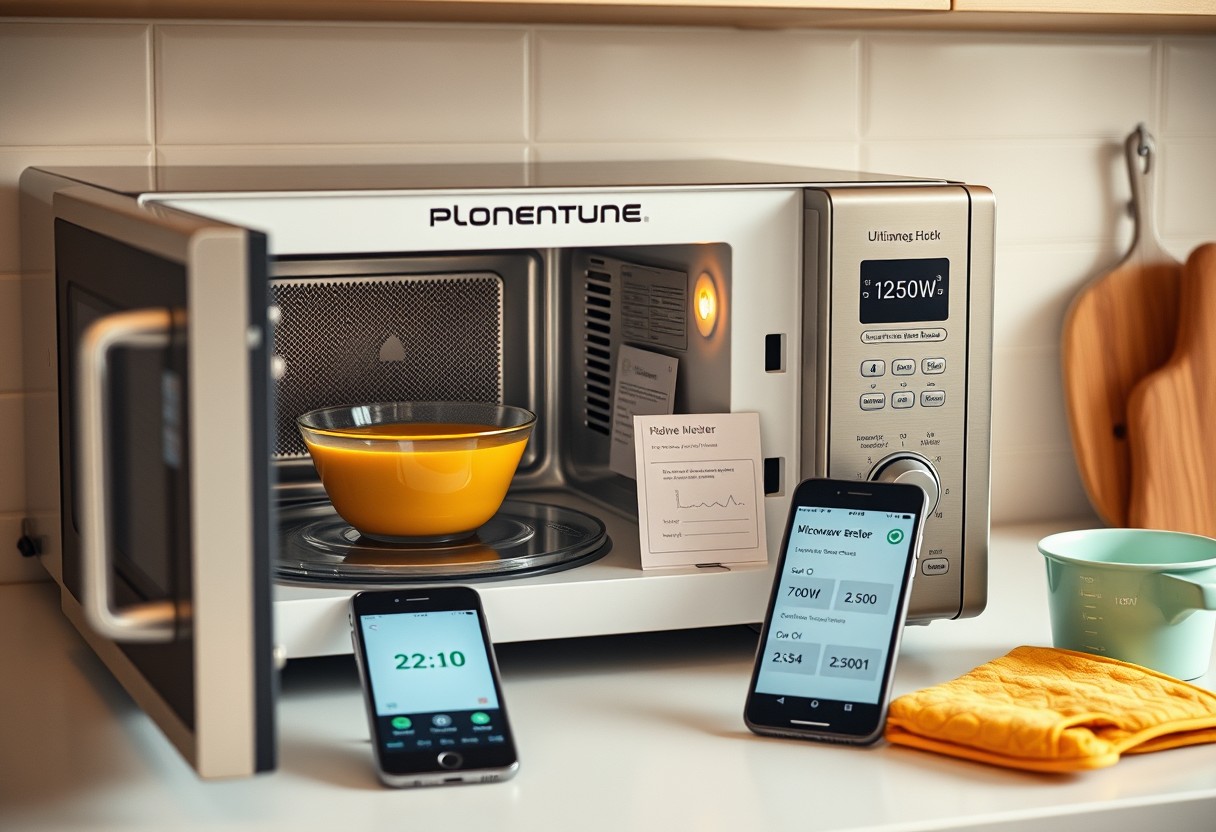
You just upgraded to a higher-wattage microwave and noticed your food cooks faster-sometimes too fast. Overcooking or uneven heating can ruin meals, but the right time adjustments prevent that. Knowing how to scale cooking times ensures better results. A 1000-watt microwave can cut cooking time by up to 30% compared to a 700-watt model, so recalculating is essential for consistent, safe, and evenly heated dishes.
Key Takeaways:
- Higher-wattage microwaves cook faster because they deliver more energy per second, so reducing the original cooking time is necessary to prevent overcooking.
- A general rule is to lower the cooking time by 15% to 25% when moving from a 700-watt to a 1000-watt microwave, adjusting in small increments for best results.
- Foods with high water or fat content, like soups or cheese-based dishes, react more quickly to increased wattage and may need even shorter intervals than drier foods.
Determining Your Microwave’s Power Output
Start by identifying the wattage of your new microwave, as this directly affects cooking performance. The number listed on the appliance determines how quickly it generates heat, and even small differences can lead to over- or under-cooked food. Most models range from 600 to 1200 watts, with higher-wattage units cooking significantly faster. Without knowing this number, adjusting cooking times becomes guesswork, increasing the risk of uneven results or food safety issues.
Locating the manufacturer’s label
Check inside the door frame, along the back, or on the unit’s underside for a label listing technical details. This tag typically includes the model number, serial number, and most importantly, the power output in watts. If you see a number like 1000W or 850W, that’s your microwave’s wattage. Never rely on the default settings or packaging claims-the actual output is what matters, and it’s only confirmed through this label.
Performing the water boil test for accuracy
Fill a microwave-safe measuring cup with exactly one cup of water and place it inside. Run the microwave on high until the water begins to boil, noting the time. If it boils in under two minutes, your microwave is likely over 1000 watts. A boil time between two and three minutes indicates a mid-range unit. This simple test provides a reliable check if the label is missing or unclear, helping confirm the actual output.
Calculating the New Cooking Time
To adjust your cooking times accurately when moving to a higher-wattage microwave, apply a simple mathematical ratio based on the wattage difference. You’ll need the original cooking time and the wattage of your old microwave, then divide that by the new, higher wattage. Multiply this ratio by the original time to get your adjusted duration. This calculation gives you a reliable starting point, though actual results may vary slightly depending on food density and container shape.
Using the wattage conversion formula
You can determine precise adjustments using the formula: (Original Wattage ÷ New Wattage) × Original Time = Adjusted Time. For instance, if a dish took 5 minutes in a 700-watt microwave and you’re switching to a 1000-watt model, the math becomes (700 ÷ 1000) × 5 = 3.5 minutes. This method delivers accurate estimates for consistent results, especially with reheating or simple cooked dishes where timing is critical to avoid overcooking.
Applying the “three-quarters” rule of thumb
When you lack exact numbers or want a quick estimate, reduce the original cooking time to roughly three-quarters of what it was. This works well when upgrading from a lower- to higher-wattage unit, such as going from 700 to 1000 watts. Start with 75% of the original time, then check the food for doneness. Stopping early prevents burning or drying out, letting you add short bursts of additional heat only if needed.
Essential Tips for Even Heating
Proper placement and movement of food are key to avoiding uneven results in high-wattage microwaves. Arrange items in a circular pattern, leaving the center open to promote uniform energy distribution. Stirring liquids and semi-solids midway disrupts hotspots before they intensify. For solid foods, rotating the dish ensures all sides receive balanced exposure. The shape and depth of your container also influence heating-shallow, wide dishes work best. Always use microwave-safe utensils when mixing to prevent damage or safety risks.
- Arrange food in a ring shape to maximize even exposure
- Stir or rotate food halfway through cooking
- Use shallow, round containers for optimal heat spread
- Avoid stacking or overcrowding items on the plate
- Cover food loosely to trap steam and aid uniform heating
Rotating and stirring midway through cycles
Turning your dish 180 degrees halfway through cooking corrects for dead zones in high-powered models. Microwaves emit energy from specific points, often leaving cold spots in stationary food. Stirring sauces, soups, or grains redistributes heat and accelerates even cooking. For casseroles or baked goods, a quick spin of the plate makes a visible difference. This simple action prevents overcooked edges and raw centers, especially in dense mixtures. Always pause the microwave safely before handling hot containers.
Monitoring for hotspots in dense foods
Thick portions like meat, potatoes, or lasagna absorb heat unevenly, with outer layers cooking faster than interiors. High wattage can scorch surfaces while the center remains cool. Check temperature in multiple spots using a food thermometer after initial heating. Letting food stand for a minute allows internal heat to equalize. Break apart or flip large items during cooking to expose hidden areas. Covering with a damp paper towel helps retain surface moisture and reduces overheating risks.
Factors Influencing Heat Distribution
Understanding how food volume and moisture content interact with microwave energy directly affects cooking outcomes. Larger volumes absorb more waves, leading to uneven heating if not arranged properly. Moisture-rich foods heat faster due to water molecules’ strong response to microwave radiation. The container’s material influences energy penetration-glass and ceramic distribute heat more evenly than plastic. For consistent results, always consider these variables before starting the timer.
- Food density determines how deeply microwaves can penetrate
- Water content increases absorption of microwave energy
- Container material impacts heat retention and distribution
- Volume and shape affect hot spot formation
Impact of food density and volume
Dense foods like potatoes or ground meat resist microwave penetration, requiring longer exposure even in high-wattage models. Because microwaves heat from the outside inward, thick portions risk being overcooked on the edges while remaining underdone at the center. You’ll achieve better results by cutting ingredients into uniform sizes, allowing energy to reach all parts more evenly. Reducing portion size also prevents dangerous temperature gaps where bacteria can survive.
Moisture content and container material effects
Foods with high moisture-such as vegetables or soups-absorb microwave energy quickly, often leading to unexpected boil-overs or scalding steam when removed. Water molecules are highly responsive to microwave frequencies, making wet dishes heat faster than dry ones. The container plays a key role: ceramic retains heat well and promotes even warming, while thin plastic may warp or leach chemicals under intense energy. Always use microwave-safe materials to maintain both safety and cooking precision.
Adjusting Power Levels for Delicate Foods
Lowering the power setting gives you far more control when heating sensitive items like custards, cheese sauces, or melted chocolate. At full wattage, these foods often overheat at the edges while remaining cool in the center, leading to curdling or scorching. By reducing the intensity, you allow heat to distribute evenly without damaging the texture or flavor. This method is especially effective for dishes that rely on smooth consistency and gentle warming. You’ll find that a slower approach produces noticeably better results every time.
When to utilize 50% or 70% power
You should use 50% power when reheating dense, moisture-rich foods like casseroles or baked goods that risk drying out at high settings. For items such as scrambled eggs or dairy-based sauces, 70% power delivers enough warmth to cook thoroughly while preventing separation or boiling over. These mid-range levels are ideal whenever precision matters more than speed. You’ll maintain the integrity of the dish without sacrificing safety or even heating, especially when stirring is limited or impractical during cooking.
Preventing overcooking on the edges of proteins
Proteins like fish fillets or chicken breasts often develop tough, rubbery edges when microwaved at full power. Dropping the setting to 60-70% slows the cooking process, allowing heat to penetrate the center without overcooking the outer layers. You’ll retain moisture and achieve a more uniform texture throughout. This technique is particularly effective when using covered containers or rotating the dish partway through. The result is tender, evenly cooked protein that tastes far closer to stove-top preparation.
To wrap up
You now know how to adjust cooking times when switching to a higher-wattage microwave by using a simple power-to-time ratio. You can confidently reduce cooking durations based on the difference between your old and new microwave’s wattage, ensuring food cooks evenly without overdoing it. You’ve learned to account for variables like container shape, food density, and starting temperature. By applying these calculations and techniques, you maintain control over meal quality while making the most of your appliance’s efficiency.
FAQ
Q: How does microwave wattage affect cooking time?
A: Microwave wattage directly impacts how quickly food heats. Higher-wattage microwaves generate more energy, so they cook faster than lower-wattage models. A 1200-watt microwave can heat food in significantly less time than an 800-watt unit. Recipes often assume a standard wattage around 1000 watts. When using a higher-wattage appliance, failing to adjust the time can lead to overcooked edges or dried-out meals.
Q: Can I use the same cooking time if I switch from an 800-watt to a 1200-watt microwave?
A: No, using the same cooking time would likely result in overheating. A 1200-watt microwave produces about 50% more power than an 800-watt model. For example, a dish that takes 5 minutes at 800 watts may only need around 3 to 3.5 minutes at 1200 watts. Start with shorter intervals and check the food frequently to avoid burning or uneven results.
Q: Is there a formula to recalculate cooking times for higher-wattage microwaves?
A: Yes, you can estimate the adjusted time using this method: multiply the original cooking time by the ratio of the original wattage to the new wattage. For instance, if a recipe recommends 4 minutes in a 900-watt microwave and you have a 1200-watt model, calculate (900 / 1200) × 4 = 3 minutes. This gives a starting point, but always monitor the food and add time as needed.
Q: Why does my food sometimes overcook on the outside but stay cold inside, even after adjusting time?
A: High-wattage microwaves can create intense hot spots, especially if the turntable isn’t functioning or the food isn’t stirred or rotated. Dense foods like potatoes or thick stews heat unevenly. To prevent this, pause halfway through cooking, stir or rearrange the food, and let it stand afterward. Standing time allows internal heat to distribute evenly without further cooking.
Q: Should I change the power level when using a higher-wattage microwave?
A: Yes, lowering the power level can improve results. Instead of running the microwave at 100%, try 70% or 80% power for longer durations. This works well for delicate tasks like melting chocolate or reheating casseroles. A mid-sized SaaS firm might not care about microwave settings, but a home cook benefits greatly from using lower power settings to avoid scorching while still leveraging the speed of a high-wattage appliance.