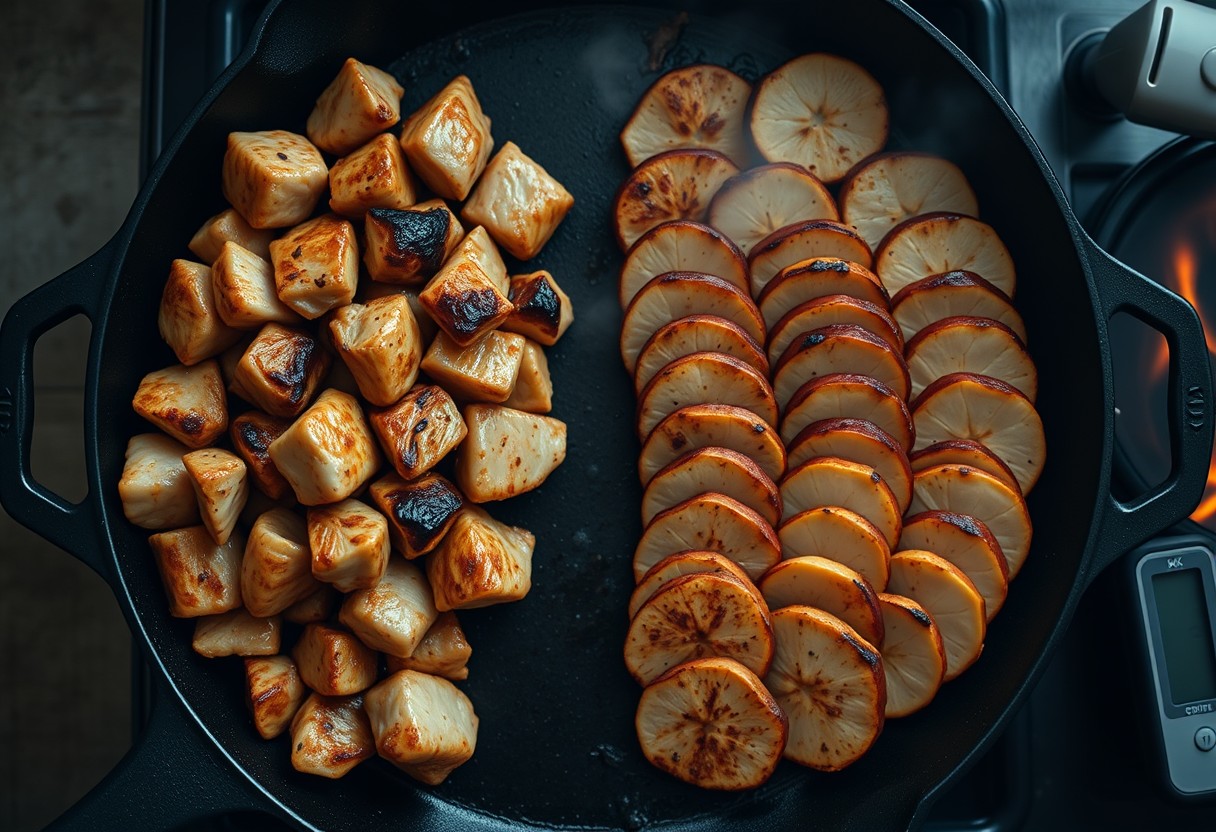
You’ve likely pulled a tray from the oven only to find some pieces charred while others remain raw. This inconsistency stems from poor ingredient arrangement and uneven heat exposure. How you place food on a pan directly impacts cooking outcomes. Improper spacing can lead to steaming instead of browning, drastically altering texture and flavor. With strategic placement, you gain control over how heat interacts with each piece, ensuring more predictable, even results every time.
Key Takeaways:
- Different areas of your oven or pan heat at varying intensities, so placing ingredients thoughtfully-like moving thicker or denser pieces toward the edges in an oven-can prevent undercooked centers and overdone edges.
- Cutting food into uniform sizes is just as important as placement; a potato chunk twice as thick as the others will always cook slower, no matter its position.
- Giving space between items on a sheet pan stops steam from trapping and promotes browning, especially with vegetables or proteins that rely on dry heat for texture.
Analyzing Heat Distribution Factors
Heat travels differently depending on what it’s moving through, and your food’s internal structure plays a decisive role in how evenly it cooks. Dense ingredients like potatoes or thick cuts of meat resist heat penetration, leading to slow, uneven cooking if not accounted for. In contrast, porous or high-moisture foods like zucchini or fish absorb heat quickly but can overcook on the outside before the center reaches the desired temperature. Understanding these differences allows you to anticipate cooking behavior and adjust your method accordingly. Thermal conductivity isn’t uniform across a dish, so recognizing material properties matters.
- Thermal conductivity varies significantly between food types
- Dense foods slow heat transfer, increasing risk of undercooked centers
- Moist, soft ingredients heat rapidly but may break down or overcook
- Fat and connective tissue alter how heat spreads through meat
- Air pockets in foods like breaded items create unpredictable cooking zones
Impact of Food Density on Thermal Conductivity
Denser foods conduct heat more slowly because their tightly packed molecules resist energy transfer. When you place a thick steak or a whole potato in a hot oven or pan, the outer layers absorb heat quickly while the center lags, creating a significant temperature gap. This delay increases the chance of overcooking the exterior before the interior is done. Foods with lower density, like leafy greens or flaky fish, allow heat to move through with less resistance, resulting in faster, more uniform cooking. Recognizing these differences helps you adjust cooking times and methods for better internal consistency.
Recognizing Hot and Cold Zones in Kitchen Appliances
Your oven or stovetop doesn’t deliver heat uniformly, and ignoring this can sabotage even the most careful prep. Most ovens have a noticeable hotspot near the heating element, often along the back or bottom, while corners tend to stay cooler. On a stovetop, the center of the burner radiates more intense heat than the edges, creating a gradient across the pan. You can detect these zones by observing browning patterns or using tools like infrared thermometers. Awareness of these inconsistencies allows you to position ingredients strategically based on their cooking needs.
Strategic Ingredient Arrangement for Uniformity
Heat doesn’t spread evenly in most appliances, so how you place food directly impacts cooking consistency. Positioning items with awareness of your oven’s or microwave’s hot zones-often along the edges or corners-can prevent scorched edges and raw centers. You’ll get better results by adjusting ingredient placement to counteract these patterns, especially when roasting or reheating. Ignoring your appliance’s unique heat behavior almost guarantees uneven outcomes, but a small shift in layout can lead to uniformly cooked meals every time.
The Perimeter Technique for Sheet Pan Meals
Placing denser, longer-cooking items like potatoes or carrots along the outer edges of the sheet pan takes advantage of higher heat exposure near the oven walls. These areas typically run hotter, helping sturdy vegetables caramelize and cook through at the same rate as quicker-cooking proteins or delicate vegetables in the center. Leaving the middle section for sensitive ingredients prevents overcooking, while the perimeter acts as a natural high-heat zone. This simple layout shift balances cooking times without requiring extra effort or equipment.
Mastering the Center-Void Layout for Microwaves
Arranging food in a ring shape with a clear space in the middle allows microwaves to reach all sides evenly, reducing cold spots in the center. Microwaves often concentrate energy toward the outer edges of the cavity, so placing items like rice, vegetables, or leftovers in a circular pattern promotes uniform heating. Leaving the center empty prevents dense clumping that leads to undercooked zones, while the open geometry lets energy circulate. Rotate the dish halfway through for best results, but start with the right layout to maximize efficiency.
Prepping Ingredients for Consistent Results
Standardizing Knife Cuts for Equal Surface Area
You achieve even cooking by ensuring every piece of vegetable, meat, or starch has the same shape and thickness. When you chop ingredients uniformly-like dicing potatoes into perfect ½-inch cubes or slicing carrots to identical rounds-each item exposes the same surface area to heat, preventing some pieces from turning mushy while others stay undercooked. A consistent cut means broth simmers predictably and roasts finish together, eliminating guesswork. Use a ruler once to train your eye; after that, muscle memory takes over.
Techniques for Flattening and Scoring Proteins
Flattening chicken breasts or pork chops with a meat mallet creates an even thickness from edge to center, so the thin parts don’t dry out before the thickest section cooks through. For dense proteins like scallops or thick fish fillets, shallow scoring along the edges allows heat to penetrate faster and more evenly. Press gently but firmly, aiming for uniformity-not pulp. When you sear or grill, this precision ensures each bite reaches the ideal texture at the same time.
Managing Temperature Gradients Before Cooking
Cooking begins the moment ingredients meet heat, but uneven starting temperatures can sabotage even the most careful technique. When you place a cold steak beside room-temperature vegetables, the disparity in internal temperature leads to inconsistent cooking-some items overcook while others lag behind. Bringing ingredients closer to ambient temperature before cooking reduces thermal shock and promotes uniform doneness. This simple adjustment ensures heat penetrates all components at more similar rates, especially critical in dishes where timing is tight and carryover cooking plays a major role.
| Factor | Impact on Cooking Uniformity |
| Starting temp difference of 20°F or more | Leads to visible doneness gaps, especially in proteins |
| Chilled dense ingredients (e.g., potatoes, meat) | Takes significantly longer to heat through, risking exterior burn |
| Room-temperature fats (butter, oils) | Promotes even searing and browning from contact |
Benefits of Tempering Ingredients to Room Temperature
Letting refrigerated items warm slightly before cooking improves heat absorption across the board. A steak taken straight from the fridge develops a gray band beneath the crust because the cold center resists cooking, while the outer layer overcooks. Tempering for 20-30 minutes stabilizes internal temperature and supports consistent texture. Dairy, eggs, and dense vegetables respond similarly-bringing them closer to room temperature allows gentler, more predictable reactions when exposed to heat, reducing the risk of splitting, curdling, or undercooking.
| Ingredient | Recommended Tempering Time |
| Thin cuts of meat (chicken breasts, pork chops) | 15-20 minutes |
| Dense proteins (roasts, whole poultry) | 30-60 minutes |
| Eggs and dairy-based mixtures | 15-30 minutes |
Staggering Entry Times for Mixed Ingredient Dishes
Dropping everything into the pan at once often backfires when ingredients vary in density and starting temperature. Instead, introduce components in sequence based on their thermal needs. Add dense, chilled items like potatoes or raw meat first, then incorporate delicate or room-temperature ingredients later. This prevents softer vegetables from turning to mush while waiting for root vegetables to cook through. For sheet pan roasts or stir-fries, this method ensures each element finishes close to the same time, maximizing both texture and flavor balance without relying solely on oven precision.
| Dish Type | Suggested Staggered Order |
| Sheet pan roast with root veggies and chicken | Root vegetables first, add chicken after 10-15 minutes |
| Stir-fry with tofu and bell peppers | Saute tofu first, add peppers and aromatics later |
| Casseroles with pre-cooked and raw elements | Layer raw bases first, top with pre-cooked items near end |
Optimizing Airflow and Pan Surface Contact
Proper spacing on your cooking surface isn’t just about organization-it’s the key to how heat moves around your food. When ingredients are packed too tightly, they release moisture that can’t escape, creating a humid environment that leads to steaming instead of browning. This effect undermines crisp textures and dulls flavor development, especially in roasted vegetables or seared proteins. To avoid this, leave at least a thumb’s width of space between items so hot air circulates freely, ensuring even cooking and consistent results across the entire batch.
Avoiding Overcrowding to Ensure Convection Efficiency
Crowded pans trap steam between pieces, turning what should be a crisp exterior into a soggy disappointment. In convection ovens or when roasting at high heat, each item needs room for airflow to carry away moisture rapidly. If you notice food steaming itself or pooling liquid in the pan, it’s a clear sign you’ve exceeded capacity. Using multiple pans or cooking in batches may take slightly longer, but the payoff is uniform browning and improved texture across every piece.
Maximizing Direct Contact for Maillard Reaction Success
The sizzle you hear when food hits a hot pan signals the start of the Maillard reaction-the chemical process behind rich, savory flavors and golden-brown crusts. For this to happen effectively, each piece must make full contact with the heated surface; lifting or crowding disrupts the transfer of energy. Arrange ingredients in a single layer, pressing them gently if needed, so more surface area touches the pan. That direct connection ensures faster, more consistent browning and deeper flavor development in proteins, potatoes, and other high-impact foods.
Utilizing Precision Tools for Doneness
Calibrating Ovens for Accurate Temperature Settings
Every degree matters when your recipe depends on precise heat. Many ovens run hotter or cooler than their dials suggest, leading to undercooked centers or scorched edges. Using an independent oven thermometer allows you to verify the actual temperature inside the cavity. If discrepancies exceed 25°F, consider professional recalibration or built-in calibration features on modern models. Consistent oven accuracy ensures your ingredients respond uniformly to heat, eliminating surprises during cooking.
| Situation | Action |
|---|---|
| Oven reads 375°F but actual temperature is 400°F | Adjust setting to 350°F or recalibrate |
| Temperature fluctuates more than 30°F | Service heating element or replace thermostat |
| Older oven without calibration option | Use external thermometer for every bake |
Leveraging Instant-Read Thermometers for Quality Control
Guessing doneness by sight or touch often leads to overcooked proteins or unsafe undercooking. Inserting an instant-read thermometer into the thickest part of your food delivers an accurate internal temperature in seconds. For meats, reaching the correct final temperature is essential for safety and texture. You’ll avoid dry chicken breasts or undercooked pork, ensuring consistent results every time. A reliable thermometer pays for itself in perfectly cooked meals and reduced waste.
To wrap up
You now understand that uneven cooking stems from how heat moves through your pan, oven, or grill and how ingredients interact with those conditions. Your choices in cutting size, placement, and cookware directly influence whether a meal finishes evenly. Crowding pans traps steam, while spacing allows browning. Dense vegetables need more time than delicate greens, so staggering their addition makes a difference. Rotating pans halfway helps counteract hot spots. By applying these principles consistently, you achieve predictable, restaurant-quality results at home-no guesswork required.
FAQ
Q: Why does food cook faster on the edges of the pan than in the center?
A: The edges of a pan typically receive more direct heat because most stovetops and ovens deliver heat from the sides or bottom, creating hot spots along the perimeter. In electric ovens, heating elements are often located at the back or bottom, which causes airflow patterns that overheat outer areas. A sheet pan filled with vegetables may show browning on the outer pieces while center items remain undercooked. Spacing ingredients evenly and rotating pans halfway through cooking helps balance exposure.
Q: Should all ingredients be the same size when roasting or sautéing?
A: Uniform size ensures even cooking since pieces of different dimensions absorb heat at varying rates. A large potato chunk takes longer to soften than a small one, leading to some parts being mushy while others stay firm. Cutting ingredients like carrots, potatoes, or onions into consistent shapes-such as ¾-inch cubes-allows them to finish cooking at the same time. This is especially important in dishes like stews, grain bowls, or roasted medleys where texture harmony matters.
Q: Does overcrowding the pan really affect how food cooks?
A: Overcrowding traps steam and blocks airflow, turning searing into steaming. When chicken breasts or steak strips touch too much, moisture released from the surface can’t escape quickly. This lowers the pan’s effective temperature and prevents browning. Leaving space between items promotes evaporation and maintains high surface heat, encouraging Maillard reactions. For best results, use two pans instead of one if cooking large batches.
Q: How does oven rack position influence cooking uniformity?
A: Rack placement determines proximity to heat sources and affects air circulation. In most ovens, the center rack provides the most balanced environment because it sits equidistant from top and bottom elements. Placing a casserole on the lower third risks scorching the base while leaving the top pale. Moving the rack to the middle allows heat to surround the dish more evenly, reducing gradients. Convection ovens benefit from this positioning even more due to fan-driven airflow.
Q: Can the type of cookware impact how evenly food cooks?
A: Yes, materials conduct heat differently. Thin aluminum pans develop hot spots, while heavy-gauge stainless steel with an aluminum core spreads heat more uniformly. Glass baking dishes retain heat well but respond slowly to temperature changes, sometimes causing overcooking after removal from the oven. Choosing the right pan for the method-like using a cast iron skillet for steady searing or a rimmed half-sheet pan for roasting-improves control over outcomes. Preheating pans also stabilizes initial cooking conditions.