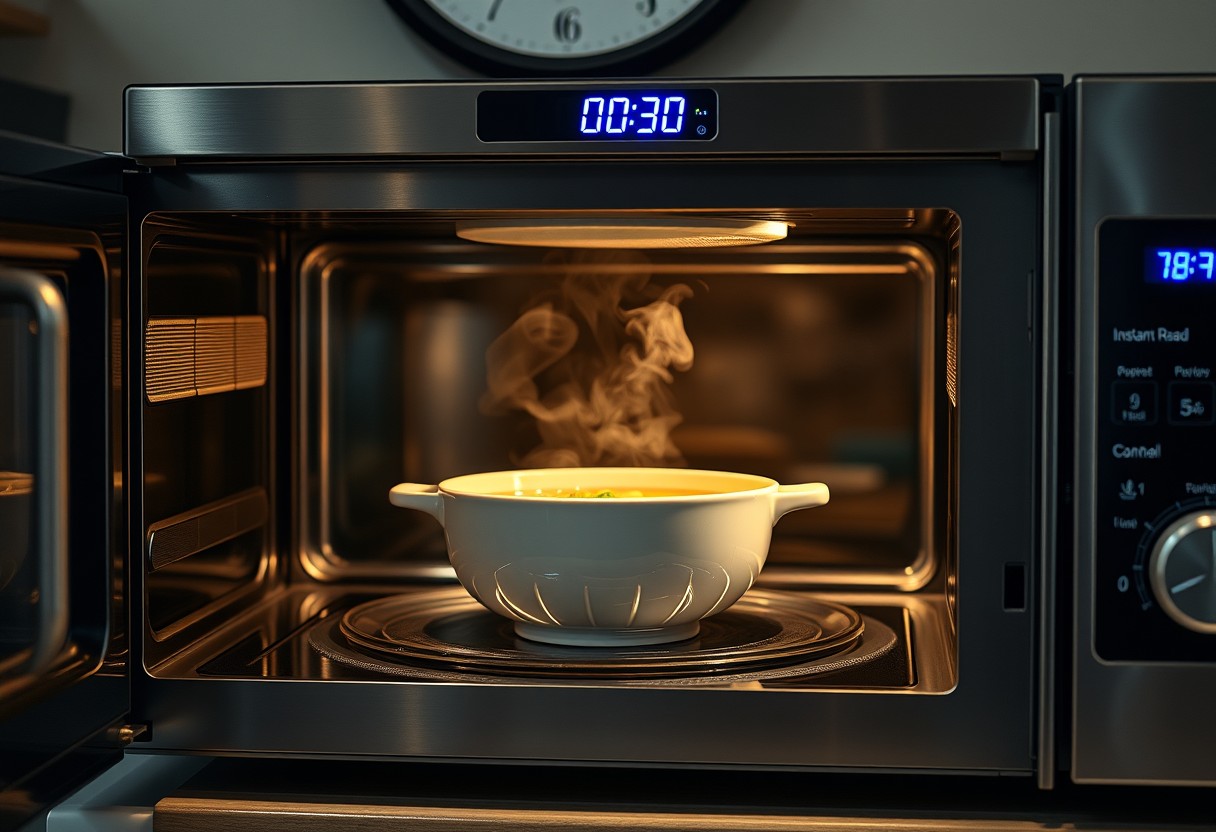
You’ve likely pulled food from the microwave only to find it scalding on the edges and cold in the center. Standing time allows heat to distribute evenly, finishing the cooking process safely. Eating immediately risks burns and undercooked spots, while waiting improves texture and eliminates bacterial cold zones. This brief pause isn’t optional-it’s a key part of how microwaves actually work.
Key Takeaways:
- Microwave standing time allows heat to distribute evenly through food by conduction, meaning the internal temperature continues to rise even after the microwave stops, reducing the risk of cold spots where bacteria can survive.
- Denser foods like potatoes or meat retain heat longer and benefit more from standing time, which helps complete the cooking process without overcooking the outer layers.
- Letting food sit after microwaving improves texture and moisture balance, preventing sogginess on the surface while ensuring the center is properly heated and palatable.
The Kinetic Chaos of Water Molecules
Dipolar Rotation Mechanics
Water molecules in your food respond to microwave energy because they possess a positive and negative end, making them electric dipoles. When microwaves pass through, the rapidly alternating electromagnetic field forces these molecules to spin back and forth, aligning with the shifting polarity billions of times per second. This motion creates intense molecular friction, which directly generates heat within the food. You’re not just warming leftovers-you’re setting off microscopic rotations that turn electromagnetic energy into thermal energy right before your eyes.
Electromagnetic Field Interaction
Microwave ovens produce an oscillating electromagnetic field at a frequency of 2.45 GHz, specifically tuned to interact with water molecules. As this field pulses, it transfers energy efficiently to polar substances, causing them to vibrate violently. The result is rapid internal heating driven entirely by electromagnetic resonance. Your food absorbs this energy unevenly depending on its composition, leading to pockets of intense activity where water concentration is highest. These zones experience extreme molecular agitation, far beyond what conventional heating produces.
The Physics of Thermal Conduction
Heat moves through your food not instantly, but gradually, driven by the fundamental principle that energy flows from hotter regions to cooler ones. When you stop the microwave, the outer layers-already energized-begin transferring thermal energy inward. You might think the cooking ends when the timer dings, but the internal temperature can rise significantly during this pause. This silent redistribution ensures more uniform warmth, especially in dense or thick portions that absorb microwaves unevenly.
Molecular Energy Transfer
Energy spreads through your meal as excited water molecules collide with their slower neighbors, passing kinetic energy like a chain reaction. You’re not just reheating food-you’re setting off a microscopic relay race where heat travels from the surface toward the center. Without this rest period, the outer zones remain scalding while the core stays underheated. Allowing time for this transfer reduces the risk of biting into a cold, potentially unsafe center while improving overall consistency.
The Equilibrium Constant
Temperature equilibrium isn’t guaranteed the moment the microwave stops, but it becomes achievable through standing time. Your food continues to cook internally as thermal energy redistributes, moving toward a balanced state dictated by the laws of thermodynamics. Though microwaves heat quickly, they don’t always achieve uniformity. This delay allows the system to approach thermal balance, minimizing dangerous cold spots that could harbor surviving pathogens if consumed too soon.

Eliminating the Bacterial Cold Spot
Microwaves heat unevenly, leaving pockets where harmful bacteria survive. You rely on standing time to equalize internal temperatures throughout the food, ensuring every part reaches a safe level. Without this pause, cold spots remain-especially in dense or thick portions-where pathogens like Salmonella and E. coli can persist. The residual heat continuing to conduct during rest is what closes these gaps, making the entire dish uniformly hot. That final diffusion phase is your best defense against foodborne illness.
Safety Standards for Core Heat
The USDA recommends most cooked foods reach a minimum internal temperature of 165°F (74°C) to be safe. Your microwave may stop heating before this is achieved everywhere at once. Standing time allows the energy to spread, helping colder zones catch up without overcooking the rest. You cannot assume safety just because steam is rising-use a food thermometer to verify the coolest section meets the standard. This delay isn’t optional if you’re serving poultry, seafood, or leftovers.
Pathogen Survival Zones
Dense clusters of food molecules can shield bacteria from direct microwave exposure, creating hidden survival zones. Even if the surface feels hot, areas deep within a casserole or meatball may stay below lethal temperatures for germs. During standing time, heat migrates inward, raising those pockets to levels that destroy dangerous pathogens. Skipping this period leaves you exposed to preventable illness, particularly with high-risk items like ground meats or dairy-based dishes. Safety depends on patience, not just power settings.
Texture Management and Moisture Retention
Allowing your food to rest after microwaving preserves its texture and keeps moisture locked in, preventing a dry or rubbery outcome. As the dish sits, internal vapor pressure stabilizes, which helps maintain the integrity of proteins-especially in meats and eggs-so they don’t expel excess water when cut or chewed. Skipping standing time forces steam to escape rapidly, leading to uneven consistency and diminished palatability. For students relying on quick meals, understanding this step can make a meaningful difference in satisfaction and nutrition, especially considering that nearly half of UC Santa Cruz undergraduates have faced food insecurity according to “Running on Empty”: Students’ Experiences of Food Insecurity ….
Vapor Pressure Stabilization
Heat builds steam within food, creating internal pressure that continues redistributing moisture even after the microwave stops. If you remove the cover or start eating immediately, that trapped vapor escapes too quickly, taking flavor and tenderness with it. Letting the dish sit allows pressure to equalize gradually, so the final texture remains even, soft, and pleasantly hydrated. This brief pause ensures the steam condenses back into the food rather than dissipating into the air, maximizing juiciness in every bite.
Carryover Cooking Effects
Residual heat continues to penetrate dense areas of your meal during standing time, gently finishing the cooking process without overexposing outer layers to microwave energy. This means proteins like chicken or fish finish firming up without turning tough, and starches like potatoes achieve a more uniform consistency. The result is a dish that’s more evenly cooked from edge to center, reducing the risk of both cold spots and dry, overcooked zones that diminish overall quality.
The Stopwatch Strategy for Different Densities
Dense proteins like chicken breasts or thick cuts of fish retain heat longer than lighter foods, requiring a longer standing time to finish cooking internally. You should let these items rest for at least five to ten minutes after microwaving, allowing the trapped heat to equalize throughout the mass and eliminate dangerous cold spots where bacteria can survive. This internal carryover cooking can raise the core temperature by several degrees, ensuring both safety and improved texture. Liquids such as soups or sauces, on the other hand, often need only two to three minutes of standing time, but must be stirred to distribute heat evenly and prevent scalding from sudden steam bursts.
Mass and Volume Calculations
Mass directly affects how long your food needs to rest after microwaving. The more volume and density your dish has, the longer thermal energy takes to migrate from the outer layers to the center. A 12-ounce steak will continue cooking far longer during standing time than a 6-ounce portion, so you should adjust your wait accordingly. Underestimating this delay can result in undercooked centers or excessive dryness from overcompensation during heating. Use weight and thickness as practical guides: every inch of thickness may require an additional minute of standing for full thermal penetration.
Insulation Techniques for Best Results
Trapping heat after microwaving enhances standing time efficiency, especially with dense foods. Covering your dish with a microwave-safe lid or a clean towel helps maintain surface warmth, promoting even heat distribution through the entire portion. This method is particularly effective for thick proteins, where maintaining external warmth drives conduction deeper into the core. Skipping insulation risks rapid cooling that halts carryover cooking prematurely, leaving you with unevenly heated food. For liquids, a quick stir followed by a brief cover prevents skin formation while preserving safe temperatures throughout.
To wrap up
You now understand that microwave standing time is not a suggestion-it’s part of the cooking process. Heat continues to move through your food after the microwave stops, equalizing temperature and finishing the job. Skipping this phase risks cold spots where bacteria survive and textures turn from tender to rubbery. Dense foods like potatoes or frozen meals benefit most from rest. You’ve seen how physics and food safety align in those few quiet minutes. Letting food stand isn’t passive. It’s an active step you take to ensure better taste, safety, and consistency every time.
FAQ
Q: Why does food continue to cook after the microwave stops?
A: Microwaves excite water molecules in food, generating heat through molecular friction. Once the microwave turns off, that accumulated thermal energy doesn’t vanish-it spreads through conduction. Heat moves from the hotter outer layers into cooler inner zones, a process known as carryover cooking. This is especially noticeable in dense foods like potatoes or meatloaf, where internal temperatures can rise by 5 to 10 degrees Fahrenheit during standing time.
Q: How long should I let food stand after microwaving?
A: Standing time typically ranges from one to five minutes, depending on the food’s density and quantity. A small bowl of soup may need just one minute for even heat distribution, while a thick casserole or baked potato benefits from four to five. Manufacturers often include standing time in cooking instructions because skipping it results in uneven temperatures and undercooked centers.
Q: Can skipping standing time make me sick?
A: Yes, in some cases. Bacteria like Salmonella or E. coli survive in cold spots if heat hasn’t fully penetrated. Standing time allows residual heat to migrate into these cooler regions, raising the temperature enough to destroy pathogens. For example, poultry heated rapidly in a microwave might register safe surface temps but still harbor harmful bacteria internally without adequate rest.
Q: Does covering food during standing time make a difference?
A: Covering traps steam, which aids in both heat distribution and moisture retention. A plate or microwave-safe lid creates a mini-steaming environment, helping delicate items like fish or vegetables finish cooking gently. Uncovered food loses moisture quickly, leading to dry edges and inconsistent texture, particularly in dishes with mixed ingredients.
Q: Why do some microwave instructions say to stir halfway through-and again after standing?
A: Stirring redistributes heat by moving hotter portions from the edges toward the cooler center. Even with standing time, microwave energy tends to concentrate in certain areas due to wave interference patterns inside the cavity. Stirring before and after resting ensures more uniform temperature and prevents biting into a scalding-hot bite next to a cold one, especially in sauces, soups, or grains.